Sunday, January 19, 2020

"Over The River And Through The Woods"--A Love Letter To Grandparents Everywhere

"Over the River and Through the Wood" was originally a poem published way back in 1844, but whenever you see or hear the words, you can't help but sing it because the words were later set to music. More recently, that well known opening phrase has become a title of a play written by Joe Dipietro, which is now showing at the James F. Dean Theatre in Summerville.

Truth be told, the play and its premise was unfamiliar to me until this week, so on opening night of the Flowertown Players presentation, going in, I had no real expectations. After seeing it, Director Sue J. Vinick and her capable cast set the bar pretty high with their performance of Over the River and Through the Woods, so next time I see the play, I will have expectations to meet.

Joe DiPietro was born in New Jersey. He is best known for writing the book and lyrics to the musical comedy hit I Love You, You're Perfect, Now Change. His most recent works include the musical comedy All Shook Up; the 2010 Tony Award-winning musical Memphis; and the 2012 Tony-nominated "Nice Work If You Can Get It." He wrote Over the River and Through the Woods in 1998 in tribute to his Italian grandparents. It played Off-Broadway at the John Houseman Theatre for 800 performances over two years.


Nick is a young marketing professional living in New York City. His two sets of loving grandparents live where they have for many years, in Hoboken, New Jersey. For the grandparents, he is the only remaining son and grandchild of the family that has not moved away. Nick judiciously goes "over the river" to his grandparent's house every week for Sunday dinner. Frank laments about his Sunday visits, "You're here, but you are not."

Nick is a very anxious young man. His grandparents say it was the reason why he chewed on his rattle when he was a baby. This one particular Sunday, he had an important announcement to make, which makes him even more anxious compounded further by the fact he can't get the four of them to focus on what he has to say. His one grandfather is having driving issues, his one grandmother is fixated on preparing him food, and his other two grandparents are sidetracked by the revelation he is seeing a head doctor.

When he finally gets them settled down, he makes the announcement. He has been offered a promotion in Seattle, Washington and is considering the move. Frank, Aida, Emma, and Nunzio are heartbroken by that prospect. So, they cook up a matchmaking scheme to invite a lovely nurse by the name of Caitlin O'Hare over for the next Sunday dinner. Whoops. Generations apart in their thinking, he wonders how he could have come from "you people." They don't understand answering machines, VCRs, or the right way to play Trivia Pursuit.

"As the play unfolds, it does so as a memory, a recollection, a remembrance not only of Nick Cristano's grandparents, but of yours and mine, too. It does not matter what we called them, what their nationalities were, or even where they lived. This is a love letter to grandparents everywhere," stated Susan J. Vinick.


Nick is conflicted with a imprudent temperament and Chase Graham passionately portrayed that shortfall through the play with comedic flare, sometimes a bit over the top--he scared the girl away. Visiting his grandparents every Sunday for dinner was thoughtful, but as Caitlin pointed out, played by Ashley-Ann Woods, he lacked appreciation for what he had in his grandparents. The cure just might be a panic attack and guess what, a few days at his grandparent's house.


Susie Hallat and Mary Anne Dyne were superbly entertaining as the food peddling Aida and the Mass card pushing Emma. Susie's mannerisms were delightfully expressive and Mary Anne's endearing accent reminded me of Anne Meara and her bluntness reminiscent of Joan Rivers. Both were flawless in their script delivery.

Fred Hutter as Frank, who was put on a boat destined for America at age fourteen by his father, was the only one of the cast that delivered his lines with an attempted heavy Italian accent. Frank's life story was an emotionally touching moment and Fred conveyed it well.

Larry Wineland as Nunzio, an Italian who faked being an Irishman to get a job, rounded out the grandparent foursome as Emma's lifetime mate. Larry was paired well with Mary Anne, but I have to say, if it wasn't for the Perillo Tours and "Tenga familia," the couple did seem more Irish than Italian, or maybe, is it Americanized, sort a speak.


Congratulations Director Sue and cast for a performance well done. There were no discernible miscues. A couple interludes were a little slow in developing, possibly due to wardrobe changes. Set was decorated and furnished simple appropriate--the automatic revolving front door was genius. Got to give a shout out to those behind the scenes--prop management and lighting well done.

Over the River and Through the Woods is a play with two different temperaments like its main character, Nick, only in a different way. The first act is lighthearted and the laughs came as fast as Aida's food, the dinner scene with Caitlin was priceless. The second act pulls a switch and takes on a more dramatic tone that tugs at the heartstrings. I would cross over the river and through the woods to see it again.


Purchase your tickets for Over the River and through the Woods.

January 17, 18, 23, 24, 25, 30, 31, and February 1, 2020 at 8pm, January 19, 26, and February 2, 2020 at 3pm

Friday, January 17, 2020

Remember The Town Hall Bell And The Stories It Tells

The master of the macabre, Edgar Allan Poe, wrote in his onomatopoeic poem, The Bells, these beguiling words:

What a gush of euphony voluminously wells!
How it swells!
How it dwells
On the Future! how it tells
Of the rapture that impels
To the swinging and the ringing
Of the bells, bells, bells,
Of the bells, bells, bells, bells,
Bells, bells, bells—
To the rhyming and the chiming of the bells!

As Poe so elegantly conveys, there is meaning in the ringing of a bell. Their presence are always bound to a story. The following collection of gathered consonants and vowels is one such story of a southern town and its esteemed bell.

In 1888, a sweeping declaration was made about this quiet, summer village just outside of Charleston that would decidedly put it on the world map, and its town planners judiciously accommodated the acknowledgment. By 1891, the pine-forested community's era of the Golden Age of the Inns was in full swing. The crown jewel of accommodations, the Pine Forest Inn, was completed and its doors swung open to welcome the influx of anticipated arriving travelers. With the ensuing growth, time, if not necessity, called for a new town hall to be built. A corner plot was chosen where the streets of West Richardson and S. Main Street intersected. The cost to build it was set at $6,250.


The planned four story building would wisely face the town's main square, an idyllic vantage point. The first floor would house a high-end grocery store called the "Tea Pot". The second floor would contain the municipal offices. On the third floor, a multi-purpose room/auditorium space would be available for special town events such as dances, plays, parties and operas. The fourth story would shelter the structures most spellbinding and controversial feature, a bell, and it would prove to be not just any ordinary bell.

In Charleston, Summerville's need for a bell came to the attention of Doctor Anthony Toomer Porter, head of The Arsenal, also known at one time as the Porter Military Academy. The bell Doctor Porter would present to Summerville hung in The Arsenal's chapel tower, Holy Communion Church Institute, where it had a long history ringing out reveille, taps, mess call, and the summons to lessons and to prayers for those attending the academy. Interestingly, like the Liberty Bell in Philadelphia, it had a crack in it. It made the short journey to Summerville in 1893.

With the installing of the historical bell, the new Town Hall was complete. It would ring out the time to the town for the opening and closing of business hours, mark worker's noon time rest period and signal knock-off time for laborers. It rang in the new years. It also served as a fire alarm, indicating by a predetermined sequence of rings, which part of town was on fire, to direct the volunteer firefighters to the correct location.

During World War II, civilians were stationed in the Town Hall bell tower as lookouts. Their task was to watch the skies for enemy aircraft and when spotted, sound the alarm. Silhouettes of enemy aircraft were pinned on the interior walls to assist the lookouts in making proper identifications. One night, the town had a scare when out of the darkened skies a plane buzzed the tower. Combined with several other suspicious incidents that night, officials were convinced the town was under attack, but fortunately, it was all a false alarm. It turned out an impulsive local boy on a training flight just couldn't resist the urge to be playful. Maybe, he heard one of the town's unattached pretty girls was on duty that night.

Children were forbidden to go up into the Town Hall belfry for obvious safety reasons, not to leave unmentioned the easy temptation presented to an impetuous youth to playfully ring the bell. Although, stories tell of savvy youngsters secretly trudging their way up through the humid darkness of the steep, creaky belfry stairs. Being the tallest building on Hutchinson Square, the view the belfry offered was often the prize. Imagine the thrill one would experience at seeing from above President Roosevelt and his entourage ride by on Main Street as they made their way to the Pine Forest Inn.

Now, visualize the chaos a person could unleash on the town with an unauthorized ringing of the bell. There was a $200 fine for anyone foolish enough to do it. A popular story tells of a physician named Louis Miles ignoring the law and ringing the bell to announce the birth of his daughter to a confused crowd that gathered below. He happily paid the fine not once, but twice for the same reason.

Time passed and the wooden building began to succumb to its age. School commencements were held in the old Town Hall. At such an event one evening, in the middle of the ceremony, an announcement was made for the attendees to leave the building in an orderly and quiet manner. Later, it was reported some of the town's officials in attendance had felt an ominous swaying. The upper floors were declared unsafe for public gatherings, in part, due to the weight of the bell in the fourth floor tower. Shortly after, the entire building was condemned and in time, the bell was removed.

The bell was stored for a time at the Street Department Maintenance Building. When Watts School, Gaud School, and Porter Military Academy merged to form Porter-Gaud on the Ashley River in 1964, the public relations person for the school contracted to obtain the bell for the new school. A group called the Sons of the Bell was formed of the alumni to raise money for a special bell tower to be built to house the old bell. Ironically, the bell would be on its way back to the place where it unleashed its first tintinnabulations and to this day hangs in the school's WATCH Tower.


Void of its most cherished part, the rickety wooden Town Hall was torn down in 1963. Plans were drawn for the replacement. This one would be built with a more time tested material, bricks. For a while, its location was uncertain. Several sites were considered, but ultimately, the decision was made to keep it at the head of Town Square. The new Town Hall was dedicated on November 14, 1969. Unfortunately, it was missing a feature that was manifestly a Summerville tradition, the bell.

Due to the town's continued growth, an annex was built next to the new Town Hall with a much bigger auditorium to relieve overcrowding at council meetings along with a room with a TV monitor for overflow crowds, and a bell tower. In 2008, though not to the scale of the original, the traditional bell was restored to the Town and was hoisted to the top of the annex. It has become a nostalgic reminder of days gone by when the opening and closing of business hours was sounded by the town hall bell.

When next in town, listen for the toll of the new bell and then, remember the old town hall bell and the stories it tells.

Visit Summerville

Source material: Summerville Sesquicentennial, Porch Rocker Collections, and other.

More Summerville stories

Monday, December 30, 2019

Lights Out For A Summerville Legend--Extinguished By The Hand Of Progress

near Sigma Road
A half a century ago, when I-26 construction began along the outskirts of Summerville, a story emerged that the resulting roadwork coaxed a ghost from the disturbed ground. An overpass bridge was under construction to reconnect the severed stretch of road known as Sheep Island. It ran from N. Main Street to 176. Thus, began the era of the ghostly Legend of the Summerville Light. It is a story Washington Irving would have coveted.

Then, on July 28, 2015, I posted a photo of Sheep Island Road (locals call it Light Road) along with its infamous story on Facebook. The ensuing response was prodigious; irrefutably confirming the Legend of the Summerville Light was Summerville’s most famous and beloved ghost story. It profoundly captured the local’s imagination over the years, mainly the younger generations, driven by their impetuous nature to satisfy their insatiable curiosity to know. Some of those who responded were doubters, but overwhelmingly many were believers. If you would like to read some of the comments, click on this link: Summerville Light. You will find the responses quite interesting.

There are variations in its telling. The following is a popular version. The story tells of a woman whose husband was a night conductor for the Summerville railroad company. Every night around midnight, you could see her faithfully waiting by the tracks with a lantern. Upon seeing the lantern, the train would make a special stop to let her husband off, and the two would then walk home arm and arm. One night the train was late. When it finally arrived and came to a stop, the workers informed her of an accident. Her husband was decapitated. His head was never recovered. Although they buried his remains, she never accepted the fact that her husband was gone. So, she went to the tracks every midnight with her lantern and walked up and down, waiting for him. Out of courtesy and compassion, the train would stop to tell her of the accident, but as time passed, it became too painful to recount it, and the train no longer stopped. People began to think she was crazy, but she continued this nightly ritual until her death. Even after the train was gone and the tracks eventually removed, the belief remained she still walked with lantern in hand, waiting for the train and her husband’s return.

If you go to where the tracks once were on Sheep Island Road just before midnight, you can hear the usual sounds of the night, crickets chirping, tree frogs croaking, and the breeze blowing through the branches. Then, at midnight, the sounds suddenly cease for some odd reason, as if a presence has suddenly quieted them. Then you see it. Usually, it is far off, a light coming your way. If you stick around for it to get closer, it will chase you, and if you are in a car, everything suddenly shuts off. It has been the case for every person who has seen the mysterious light.

In the November 12, 1970 edition of the Evening Post, Sandra Baxley wrote in a first-person account, “Nothing can match the feeling of amazement when you see what you had not expected to see.”

She continued, “Directly in front of the car, at what might have been 200 yards, was an orangish light about the size of a golf ball. The darkness around it had a hypnotizing effect, and I moved my eyes to the right and the left. The color slowly changed to a bluish tint and may have become larger.”

Baxley said she was dumbfounded to learn only two out of her five friends had seen anything. Then, she said, the light reappeared. “This time, we all saw it.” She concluded, “We saw enough to make us keep our rain boots handy.”

Bruce Orr, a retired criminal investigator of Berkeley County and a researcher of legends and lore, has appeared on Ghost Hunters and Ghost Adventures. He wrote about his own experience with the Summerville Light in his 2011 book Haunted Summerville, South Carolina.

After a scary first encounter with the light one night, he related the occurrence to his wife, who didn’t believe him. He needed witnesses. The following is his second account.

“Back home, the disbelief continued. That weekend, I took my wife’s brother, who was in the Navy, and a friend who was in the Coast Guard out to Sheep Island Road. Both did not believe my story. I did the same thing, just as Johnny told me, and once again, I deliberately did not turn around. Sure enough, the light came so close that it lit the interior of the car green. It was the size of a basketball and hung in midair. As I listened to two grown men whimper, I was glad the seats in my cruiser were vinyl and prayed they wouldn’t test their waterproof capabilities. The light stopped about a car’s length away and burst into hundreds of firefly-sized lights that dissipated. We all started breathing again and went home. I never doubted Johnny ever again, and those two never doubted me again.”

Concerning his two experiences, Bruce Orr said this, “I cannot say that what I encountered on Sheep Island Road in the mid-‘80s was the ghost of the conductor’s wife, but it is definitely something I cannot explain over twenty-five years later.”

Remnants of the road as seen from Sigma Road
At one time, Sheep Island Road was a favorite place for young men to take their dates to park for a little secluded romance, only to make a harrowing quick exit due to the intruding light.

In time, town officials blocked the road to travel and posted no trespassing signs. The picture I took in 2015 verified that fact. Isolated and dangerous, the local police patrolled it regularly. Only the foolhardy daredevil would consider venturing beyond the barricading dirt mound.

The original barricades

One of the original no trespassing signs
Subsequently, the unstoppable freight train called progress once again changed the landscape around the same I-26 real estate and quite possibly has closed the chapter on the Era of the Summerville Light. The Nexton I-26 connector was constructed. The overpass leading to the dark, overgrown, and wooded hollow is no longer there. Only remnants of the once haunted stretch of Sheep Island Road remain.

As you enter the Nexton Parkway exit off I-26 to go north, quickly look to your right, you may catch a glimpse of the remaining tattered pavement. It briefly touches Sigma Drive and then crosses Nexton Parkway extending northward parallel to the new Del Webb Community and on into obscurity.


There have been no recent reports of the Light. Perhaps, the old widow finally realized the futility of being stuck in the past and extinguished her lantern, possibly forced to do so due to the area’s changes. Additionally, the generation it fascinated has gotten older and moved on.

The Light, as with the North Main Street Arch, the Pine Forest Inn, the Arcade Theater, and the Summerville Railroad Station, is gone but not forgotten as a growing southern town 23 miles outside of Charleston re-imagines itself as it closes one chapter to open another.

Saturday, November 30, 2019

Flowertown Players A Doublewide, Texas Christmas--So Good You Can't Pass It Up

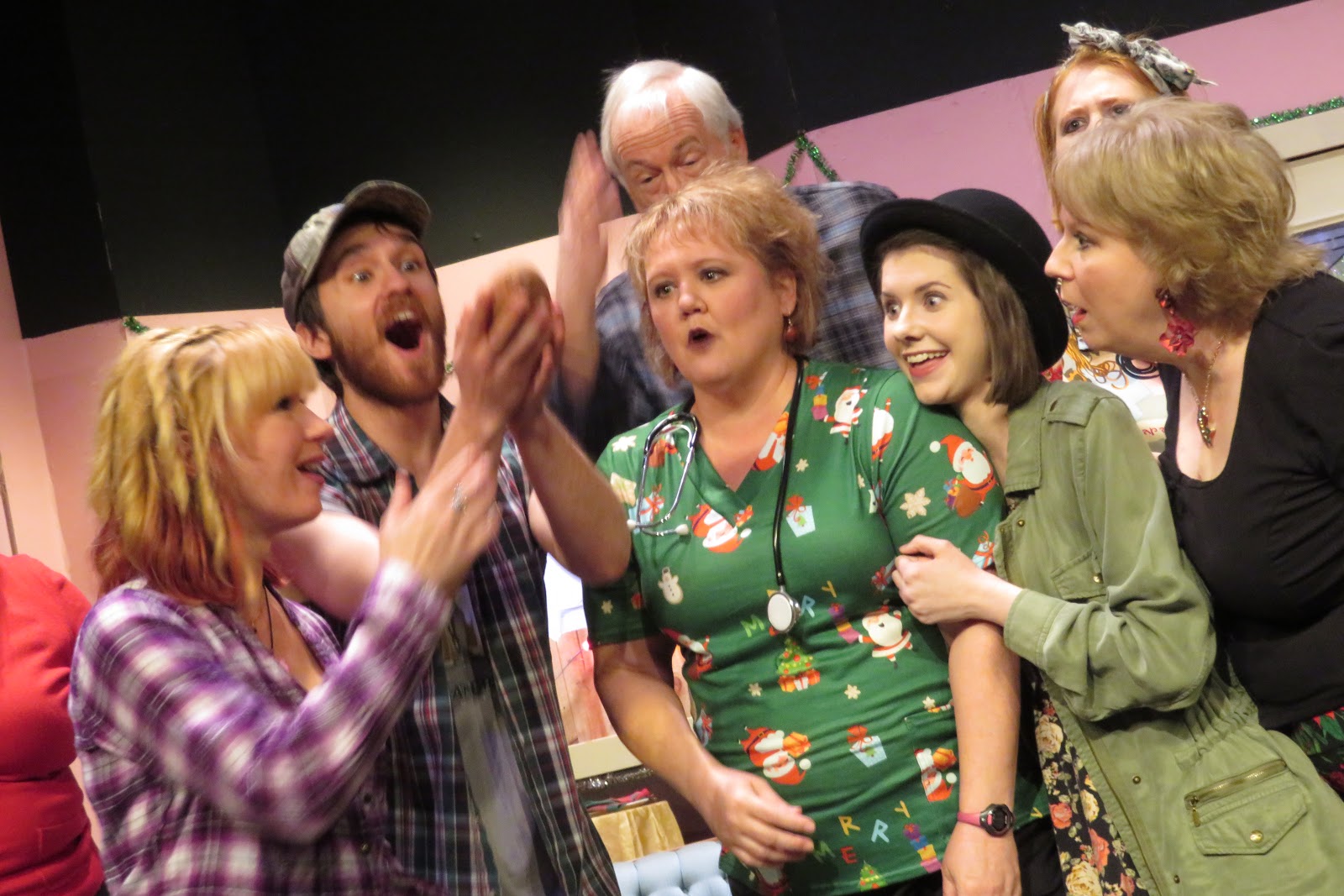
Now showing at the James F. Dean Theatre, A Doublewide, Texas Christmas is as wacky as a play can get and despite a couple glitches, after all was said and done, it all ended up putting a doublewide smile on the opening night audience.

A Doublewide, Texas Christmas, written by Jessie Jones, Nicholas Hope, and Jamie Wooten, is a comedy about the newest and tiniest town in Texas with double trouble. Not only are the trailer park residents dealing with the stress of the holiday season, but they've just discovered that Doublewide's official incorporation papers are in jeopardy. So, to bolster their legitimacy, this enclave of eccentric Texans determine to throw themselves into the County-wide "Battle of The Mangers" competition and then, conspire to win this contest with their "Nativity At The Alamo" entry, by any means possible.

Certainly, Mayor Joveeta Crumpler has her hands full, but there is more. She has to somehow wrangle in her celebrity-obsessed mother, deal with her besieged brother who is being harassed by a army of vengeful Santa Anna raccoons, and attend to a best friend who has been dating every loser this side of Tugaloo and Tinsel. To make matters worse, Joveeta finds herself increasingly wary of the newest fresh out of the loony bin resident, Patsy Price.


With his foot propped up on a chair and dressed in festive pj's at final dress rehearsal, veteran Larry Spinner did what is expected of director's; he honed the finer details of the crazy chaos about to be unleashed unto the opening night stage and orchestrated the capable kookie cast with carefully employed suggestions. But, he did not accomplish this on his own. He was assisted by the very talented queen of wacky, Heather Hogan. A stand out from one of the funniest shows of the year, The Red Velvet Cake Wars, Heather is usually seen on stage. This was her first go at assistant directing.

If being wacky was a prerequisite to land a part in Doublewide Christmas, each of the cast members fit the tone of the script nicely. Jennifer Post as Big Ethel Satterwhite superbly set the tone for the play in her opening address with a slew of one liners.


Courtney Bates stole the show in her portrayal of the frazzled Mayor Joveeta Crumpler, who found herself in compromising positions on a couple occasions, one being on an exercise ball with Texas sequenced across her Doublewide ars, the other manifested her prowess to think on her feet.


The honorary title of most wacky goes to Chase Graham as Baby Crumpler. From the moment his character got zapped by the Christmas lights to being harassed by menacing raccoons, he convincingly appeared to be having fun as he energetically ran from scene to scene like he was one sweet potater away from a certifiable psychotic breakdown, and the two-legged elf hat he wore was the crown of wackiness.


The character, Lark Barken, is wacky sprinkled with sweetness and Maddie Latham was the perfect choice. Her facial expressions are priceless and delivers her lines laced by a matching overtone with a lilting inflection. Maddie's character is pivotal to a plot that gets muddled in all the wackiness, until the end, when like a balloon suddenly springing a major leak, drops out of nowhere.

Erin Larsen plays the part of vengeful Patsy Price who is said to be about as fun as a case of shingles by her brother, Haygood Sloggett, portrayed by John Lowther. Unlucky in love Georgia Dean Rudd is played by the hard working Joy Springfield. As Joveeta's wanna-be celebrity mother, Caprice Crumpler, Debra Glovier's moment in the spot light was when she sang a solo outfitted in a sparkling red dress and Jonathan Quarles carried the double role of Nash Sloggett and Texas' gift to women, Harley Dobbs.


A Doublewide, Texas Christmas is sure'nuff funny, but that ain't all there is to the play if you are able to dig through the "-ness" of "a few pickles short of a barrel." Larry Spinner summarized it this way, "Through the laughter, it reminds us of the need to be compassionate and forgiving. Anger and revenge are self-destructive, and everyone deserves a second chance. Most of all, I feel this show is a story of hope: never give up hope for a better future."

As a Texan would say: A Doublewide, Texas Christmas--"you can't beat that with a stick". So, "you have two different buckets of possums"--first, picking your day to see the show and then, purchasing your ticket.

Purchase tickets.
November 29, 30, December 5, 6, 7, 12, 13, and 14 at 8pm, December 1, 7, and 14 at 3pm


Stage Manager/Sound Operator-Alexa Jordon, Costume Designer-Patti Kelly, Props Master-Nicole Coke, Set Design-Ernie Eliason and Courtney Bates, Lighting Designer-Ernie Eliason, Sound Design-Larry Spinner and Courtney Bates, Set Construction-Ernie Eliason and Chrissy Eliason, Wardrobe Assistant-Emma Wood, Set Construction/Lighting Operator-Ayla Camp

Sunday, November 17, 2019

'Tis The Season To Ice Skate--The Town Of Summerville And Summerville DREAM's Gift To Its Residents And Visitors

This past week snowbird winter made an early surprise visit to Summerville and the Lowcountry. However, if you are a reader of The Old Farmer's Almanac, you were anticipating Old Man Winter's sudden early arrival. So far, the long range forecast for the Southeast Region has been spot on.

According to the weather prognosticator, it prognosticates "Winter will be warmer and rainier than normal, with below-normal snowfall. The coldest periods will be in mid- to late November, early to mid-December, and early and late February. The best chance for snow will be in late February in the north." I have always said, "If it is going to be cold, I'd rather see it snow."

There is a certain beauty in freshly fallen snow. How it fondly clings to the needles of the pine tree branches and blankets the landscape with a sense of tranquility. The quiet is so overwhelming you can hear the air. It is the perfect time to grab the shovel and head to your favorite lake or pond, scrape away a section of snow from off the crystal clear frozen water, and strap on the ice skates. It is one of the simple pleasures of the season.

Snow is a rarity in Summerville and the Lowcountry, even when it is cold enough. Usually, when it is cold enough, there are no clouds to produce the needed precipitation. Though it adds to the aura, you don't need snow to ice skate. All you need is the ice. With that having been said, aside from the arrival of the early Southern style winter weather, something else is coming this month of November. Summerville will have their very own ice skating rink thanks to the Town and the imagination of Summerville DREAM.

The overflow parking lot at 208 S Ceder Street just south of West Richardson is being transformed into an 40' by 80' outdoor ice skating rink just in time for the holidays. "The boxed structure comes with all the piping. It's a glycogen system. It runs through a chiller," said Steve Doniger, the executive director of Summerville DREAM. DREAM has been overseeing the building and will handle the operations for what is called Summerville Skates.


The skating rink is owned by a husband-wife team called Ice Games 88. Wayne Seybold, along with his sister Natalie, performed around the world and represented the United States at the 88 Calgary Winter Olympic Games in the couples competition. The brother/sister team was the first to successfully land the throw triple lutz. Jennifer Seybold has performed in shows around the United States including an ice show at the Carowinds amusement park. Clearly, they bring to the table 40 years of experience in the area of Figure Skating and 20 years in the portable skating rink business. They were present when the work of laying out and assembling the system began.


Listening to Doniger talk about the planned rink, you can tell the DREAM team is dedicated to making it a success. The rink will afford the opportunity for the community's families and kids to enjoy something different this coming holiday season. "We want to do interesting things to show the quality of life in Summerville is such that they want to grow up here and invest here." Of course, its overall success will depend greatly on the residents themselves and a little cooperation from the weather.

Molly Willard, Director of Development/Promotion and Design, provided a proposed layout she has been working on to give an idea of what the finished seasonal ice rink will look like. There will be parking available on site, bleachers for seating, picnic tables, sponsored concession stands, and a possible split rail fence. My fanciful idea: How about a snow making machine for one of those rare cold days. Wouldn't that make for a interesting picture.


Summerville Skates will be open to the public, birthday parties, group events and community fundraisers throughout the winter season. The Flowertown Players have already scheduled an event to promote their production of Disney Frozen Jr due to open in March. In fact, auditions for the production will take place on the very day the rink opens, Saturday, November 23rd at 6 pm. So, stay up to date by checking out Summerville Skates' web page or their Facebook page.

So participants can get the most out of their experience and for safety reasons, the maximum number of people on the ice at any given time will be limited. You will need to reserve your day and time to guarantee your spot. General admission is $8 and an additional $4 to rent skates, but with the discount opportunities planned, Doniger said the average cost for a family will be $20 to $25.

Summerville Skates will run from November 23rd through January 11th. Over three hundred pairs of skates will be available for rent. Group sales and rink rental packages will be available. Hours of operation will be Monday-Friday 3-9 pm and Saturday and Sunday 11 am-9 pm.

Summerville Skates' slogan is Happiness is... ice skating. Enjoy the video.

Tuesday, October 15, 2019

Immerse Your Tea-buds Into Summerville Tea Emporium's Extensive Inventory Of Loose Leaf Tea

Enter through this door located at the corner of N Magnolia St. and E 2nd N St. in Summerville and you will embark on a journey into the diverse world of loose leaf tea brought to you by Old Barrel Tea Company and hosted by proprietor, Maggie Brooks. With blends like Pumpkin Pie Chai, Blood Orange and Lemongrass, and Coconut Black and Vanilla Rooibos, all you Lowcountry tea lovers wouldn't want to miss it for all the tea in China.


Old Barrel Tea Company is a female run, family business, and there is nothing dainty about this group of tea vendors. For this mother/daughter collaboration, Dana Huffman and Bailey Riddle, tea is more than just an afternoon break. It is a way of life. "We drink tea and tisanes for breakfast, lunch, dinner and all the time in between. We don't put our pinkies up while drinking tea," is part of their motto. Rounding out the tea cadre are Dana's daughter-in-laws, Paola and Nenada. Paola does all of the blending at the business's warehouse.

Old Barrel Tea Company had its beginnings in Ruidoso, New Mexico, but through the endeavors of Maggie Brooks, it is fitting O.B.T.C. has found its way to the place where in the early 1700's tea bushes, also known as Camellia Sinensis, first arrived in the United States from China and in due course, through the efforts of Dr. Charles Shepard and Summerville's Pinehurst Tea Plantation, American grown tea become a reality by 1888.

Maggie grew up in Florida and like most Southerners drank sweet tea. She attended Jacksonville University where she acquired a Bachelor’s Degree in Marine Science. After graduating, she moved to New Mexico and worked for the White Sands National Monument--the world's largest gypsum dunefield with glistening white sands engulfing 275 square miles of desert making it one of the world's great natural wonders. She was there for four months.

After leaving White Sands National Monument, Maggie worked at a high school for 2 1/2 years. It was there she met Bailey, who introduced her to her first loose leaf tea experience--a Pu-Erh tea. It was then her career would take a different path. With passion in her voice, she recounted how she petitioned O.B.T.C. with the request, "Please let me work for your company." Her heart felt plea did not go unanswered. Maggie considers herself the adopted daughter of the Huffman clan.


With a husband in the military, Maggie, along with their daughter, ended up stationed in Myrtle Beach. While doing a Google search for festivals in South Carolina, Summerville's Sweet Tea Festival popped up. She came in contact with Summerville DREAM and a partnership was entered into. The Summerville Tea Emporium was created. Wine barrels were brought in and iron pipe topped with wood shelving were installed on the walls. Over 30 different blends of tea with emphasis on flavor and wellness are offered along with raw, unfiltered honey and various other products.


Summerville Tea Emporium is a neatly arranged, welcoming space. Maggie greets you with a warm smile and possesses a commanding knowledge of her products. Her love and conviction for O.B.T.C. and its goods is unmistakable. Of the three taste offerings presented on my visit, the Blood Orange and Lemongrass--a lightly tart blend full of citrus flavors and naturally caffeine free--was my favorite. The color of the brewed blend was inviting to the eye and the flavor was soothing to the palate. The shop's blends are so voluminous that even the most discriminant tea drinker will not go away unsatisfied.


Old Barrel Tea Company's web blog is called A Dose of PositiviTea and is managed by Maggie. Check it out by clicking here. You will find recipes, product summaries, tea suggestions, and a boun-tea of loose leaf tea trivia.


Summerville Tea Emporium's official opening will take place with a ribbon cutting on Friday, October 25th at 3-6 pm. On Sunday, October 27th, there will be a Garden Tea Party at 1-4 pm.

Wednesday, September 18, 2019

The Symbol Of Hospitality In A City Of Hospitality--From A Fence Post To A Famous Landmark

I succeeded at producing one of these tasty fruits after pampering its parent plant for two years in a container pot with sweet results. The seed-bearing structure looks like a giant pine cone and shares a name with another popular fruit, the apple. Thus, this colorful, cylindrical edible has become known as a pineapple.

You might question the seed-bearing reference because what you buy at the market has no seeds, but there is a reason why and it will be explained later. And, aside from being a cherished delicacy the world over, it has been a colorful symbol in America's social history.

The pineapple is native to southern Brazil and Paraguay where wild relatives occur. The indigenous tribes eventually spread it up into South and Central America and from there to the West Indies. In 1493 Columbus found the fruit on the island of Guadalupe and carried it back to Spain. since, it was spread around the world on sailing ships of various countries.

In the wild, pineapples are pollinated primarily by hummingbirds, but certain wild pineapples are foraged and pollinated at night by bats. Interestingly, one of the primary places where pineapples have been cultivated, hummingbirds are banned. Hawaiian State law forbids hummingbirds. Pollination by these small birds is not wanted. If the flower pollinates then seeds will develop and that is not desirable in the fruit for the market. Instead, pollination is performed by hand. Ananas, Nanas, and Pina are other names it is known by. The Tupi word Nana meant "excellent fruit."

European explorers coined the name pineapple, referenced for the first time in 1664. In the colonial days of America, legend says when a sea captain returned to his home from a long voyage, he would spear a pineapple on his fence post to let his friends and neighbors know that he had returned safely. They would come over for dinner that night to drink and the captain would entertain them with tall tales of travels to exotic new lands. Through this practice, the pineapple earned its symbolic meaning as a sign of welcome and hospitality.

As the tradition and legend of the pineapple spread, colonial innkeepers added the pineapple to their signs and advertisements. Bedposts carved in the shape of a pineapple were a common sight at inns across the colonies.

The practice of using it as a symbol of hospitality is still carried on today by hotels and service industries.


The Maxwell Hotel in Seattle incorporated the pineapple as a symbol and it is found throughout the hotel. It is located at 300 Roy Street.


The Pineapple Inn is a Nantucket Luxury Hotel in the heart of the Nantucket Historic District offering suites for all needs and tastes since 1838. It is located on 10 Hussey Street, Nantucket, Maine.

As you wander through the stately homes of historic Charleston, you will observe it carved by artisans and craftsmen into fireplace mantels, sculpted into lintels and on some pieces of jewelry.


It became a favorite motif of architects. You will see it displayed throughout Charleston's historic landscape. It can be spotted on doors, atop gates, and most notably in one of the city's most popular destinations, Waterfront Park. The Pineapple Fountain opened in 1990 and has been a focal point of the park. It is one of Charleston's most photographed landmarks. Children are frequently seen splashing in the fountain, where wading is not only permitted but welcomed.


Around 1800, Francis Simmons, a Johns Island planter, built the neoclassical house located in the lower peninsula of Charleston at 14 Legare Street. It is famous for its large, brick gates with decorative wrought iron. The gates were installed by George Edwards, who owned the house in 1835. They bear his initials and include finials that were carved to resemble Italian pine cones. The finials are frequently referred to as pineapples by locals and the house has become known as the Pineapple Gates House.


If you should be driving in the historic district of Summerville on West Carolina, you will pass two houses with stone pineapples mounted on their brick fence entrances. As you drive passed, recall the old story of the sea captain spearing a pineapple on his fence extending hospitality to his neighbors.


Another place in the historic district of Summerville you will catch a glimpse of this custom being portrayed at an entrance is on W. 2nd S. Street.


On E Richardson sits a house built in 1858. The house has been recognized in several magazines and has been awarded a certificate from the Summerville Preservation Society. With an entrance flanked by red pineapples, It was at one time a bed and breakfast.


From a sea captain's fence post to colonial inn bedposts, the pineapple has invoked a sense of hospitality. It has inspired inn keepers to use it as a symbol on their establishments and architects and artisans to incorporate it into their works of art found throughout early American colonial history. Its supremacy as a welcoming symbol continues today. How sweet the "excellent fruit" is.