
Showing posts with label Botany Bay Beach. Show all posts

Friday, October 12, 2018

An October Visit To The Once Upon A Time Wealthy Bleak Hall Plantation--Facts And Lore

Bleak House in the book
One of Dickens' finest novels, Bleak House was inspired by an actual court case in the English judicial system that dragged on for more than 50 years. It combines two tales: the story of wealthy Lady Dedlock and that of penniless Esther Summerson. The haughty noblewoman of Chesney Wold and the orphan housekeeper of Bleak House become entangled by the court case Jarndyce and Jarndyce, a mess of disputed wills and disrupted inheritance that has tied up the High Court of Chancery for decades. The story has a twist in it--Esther Summerson has a distinctive interconnection with Lady Dedlock, and I will leave it there.

There is some contention as to the real house that was the inspiration for the house in Dickens' story. A house located in Broadstairs, England, was a consideration. Dickens stayed with his family at this house (then called Fort House) for at least one month every summer from 1839 until 1851. However, there is no evidence that it formed the basis for Bleak House, particularly as it is so far from the location of the fictional house. The house sits on a cliff overlooking the town's waterfront on the Isle of Thanet. It was renamed Bleak House in honor of Dickens.


An 18th-century house located on Folly Lane in St Albans, Hertfordshire, the place where Dickens wrote some of the book, has also been identified as a possible candidate for the house in the story since the time of the book's publication and was known as Bleak House for many years.


Dickens' Bleak House story became a part of the Lowcountry's Sea Island history around the same time of its publication in 1852. In the late 1790's, a parcel of land located between today's Seabrook Island and Edisto Beach was being developed by Daniel Townsend III, who built a mansion on the property in 1805.

In 1842, his son, John Ferrars Townsend, inherited the plantation and became one of South Carolina's largest planters of Sea Island cotton. His cotton commanded a high price from lace-makers and won several prizes for both its quality and its length. Townsend was also a political leader serving in the South Carolina Senate, South Carolina House of Representatives. He attended the Secession Convention as a delegate and signed the Ordinance of Secession.

John Townsend was an admirer of Dickens. As a result, he was inspired to name his plantation after the house in Dickens' story with a slight difference, Bleak Hall. The original great mansion of Bleak Hall was two-and-a-half stories high on a raised basement. A distinguishing feature of the mansion, a cupola, was later added after the house was built so the homesick bride of one of the Townsends could look across the river to her former home on Wadmalaw Island. It towered over the surrounding oriental gardens and the now famous ice house, which still exists and is an outstanding example of Gothic revival architecture.

At the outset of the Civil War in 1861, by orders from the Confederate government, the steamboat "Beauregard" evacuated everyone from Edisto Island and the plantations. Both Confederate and Union troops used the cupola on Bleak Hall as a lookout. At the wars end, the plantations laid devastated. The valuable silver, china, and furniture that was left behind by the Townsends were carried away or destroyed by Freedmen and the Federals. When the Townsends returned in 1866, the house was occupied by former slaves. Shortly thereafter, it burned down. A new one was built in its place, but later torn down and a modern house was built nearby, which also disappeared in time.
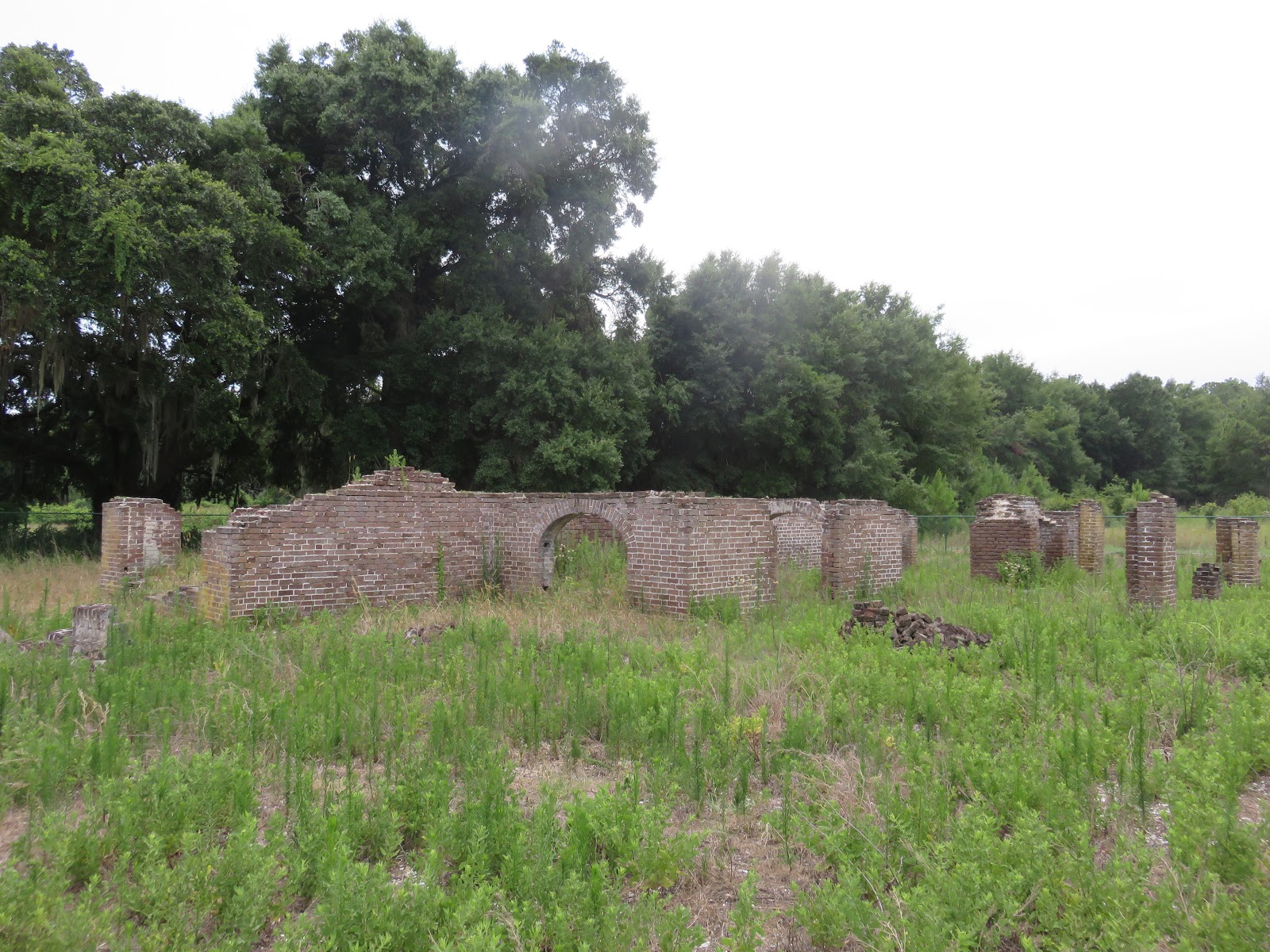

Like all Southern plantations, legends abound. One involves a "bee hive well" called Jacob's well--a well surrounded by a wall of tabby with a steeple-shaped roof and the name "Jacobus Fecit" cut into one of its sides. In its early days, it was rumored to be a place where lovers secretly rendezvoused. It is believed a little gray man stands guard over the well to keep its waters pure and only allows the "pure in heart" drink from it.


Another story involves the plantation cemetery located at the fork in the road where you turn right to go to Bleak Hall or left to go to Sea Cloud--another plantation located nearby. After leaving a clearing, you enter a narrow road surrounded by dense undergrowth and trees. Here you will feel the first wave of hot air hit the back of your neck, then again and again until you leave the area. The slaves believed this hot air to be the "Hags breath" and if you linger, she will cast a terrible spell that could even cause your death.

A third legend speaks of a Portuguese man wearing large gold earrings and a red bandanna fashioned into a turban who roams the shores of Botany Bay. Seven of his victims were discovered on the beach--all of them standing straight up in the sand.


And then, there is the Mystery Tree. It is located at the entrance of the road that led to Bleak Hall and Sea Cloud Plantations. Those who have seen it are amused by the oddities that decorate its branches, which mysteriously change from time to time. Some have suggested it to be an object known to the Gullah culture as the bottle tree. In the African culture, bottle trees are placed in a spot where evil is known to have dwelt. The tradition purports evil crawls into the bottles to destroy the beauty it reflects, becomes trapped, and is destroyed by the illumination of the rising sun. It is true the Botany Bay plantations owned slaves during their Antebellum period to work their sea island cotton fields. As to the Mystery Tree, I have not seen bottles on it to suggest this belief. 

Today, Bleak Hall and Sea Cloud have been combined to form the Botany Bay Plantation--a wildlife preserve consisting of 3,373 acres. Formed in the 1930's by Dr. James Greenway, it got its name from the barrier island that was near, but not a part of the Bleak Hall property--Botany Bay Island. Some of the island's previous names were Tucker Island, Watch Island and Clark's Bay. The last owners, John and Margaret Meyer, deeded the property to the state.


Botany Bay Island was much larger in the early days of Bleak Hall Plantation--covered with an impenetrable tropical jungle of wild oaks, palmettos, and cedars just twenty yards from the shoreline. Over the years, the ocean has encroached on the land. Now, only a narrow, pristine strip of beach two miles long and lined with a sun-bleached bone yard of weatherworn dead timber remains--loved by photographers. It was separated from the large plantation by an inlet and a smaller island named "Porky," a shortened name from "Pour-quoi." While crossing the marsh to the beach, you will pass an outcropping of trees and plants called Hammock Island. The beach was significantly eroded by Hurricane Matthew and was closed for awhile, but has since opened.

Botany Bay Plantation is a magical place with a secluded beach unsurpassed on the Atlantic coast and located on Edisto Island not far from Edisto Beach. In fact, from Botany Bay's shell-covered beach you can see Edisto Beach to the right and Seabrook Island to the left.


You can take a tour of Botany Bay Plantation featuring 15 points of interest by car. Keep an eye out for the Portuguese man and do not linger near the cemetery if you feel a waft of hot air on the back of your neck.

Friday, October 10, 2014

Now Barely A Whisper In The Wind With A Ghost Of A Story, Edingsville Beach Was A Haven Of Grandeur And Extravagance

As the legend tells, in the hazy cast of a summer’s blood moon, when the ocean air is heavy with a salty mist, you just may see the glazed shadow of the moon's dim light dance its somber dance on the window panes of the once upon a time sea island planter's homes an oyster toss from Botany Bay along a stretch of deserted island sand. And if you carefully listen to the tempestuous breeze passing over the sand and through the scattered relics washed ashore by the agitated surf, you possibly may hear the faint laughter and decadent chatter of the souls who past the time here during the burdensome heat of the malarial months of mosquito infested inland Edisto. But do not linger, for out of the translucent shadows, you may unexpectedly be enlisted by an illusory woman walking the beach mournfully searching for her husband long past due from a distant land.


Today, this hauntingly seductive shoreline is a windswept, sea-shelled stretch of solitary sand located between Edisto Beach and Botany Bay Beach (see map). You would be looking from Botany Bay for a glimpse because there is no access to the beach other than by way of a causeway used exclusively by the residents of Jeremy Cay—a gated community separated from the beach by a salt marsh. You arrive at the gates of Jeremy Cay by way of a moss covered, oak lined road called Edingsville Beach Road. The very same road that led the families of the aristocratic Sea Island planters of Edisto to their beachside, summer resort once called Edingsville and the beginning of the story.


With the 18th century closing out and the 19th beginning, Edisto planters were fast becoming the wealthiest plantation owners in the South due to Sea Island cotton. Silky and highly prized, Sea Island cotton boasted extra long fibers making it a variety avidly sought after by mill owners of the world. Their unbelievable wealth empowered the planters to establish an aristocracy reinforced in blood and marriage.

They built beautiful mansions, bought townhouses in Charleston and entertained lavishly, but in the summer months their plantation paradises languished in summer’s oppressive heat besieged by swarms of mosquito and the dreaded “country fever,” also known as malaria. While seeking relief on the barrier island beaches of the Atlantic, they discovered the cooling ocean breezes kept the scourge at bay. With this realization, the idea of Edingsville Beach was born.

Sea Island plantation

The little island was accessible only by water until around 1800, when Benjamin Edings built a causeway from Edisto Island and began selling or leasing lots on the beach to local planter families. By 1820, the beachside resort of Edingsville had grown to include sixty stately two-story, brick houses wrapped in terraces with sweeping views, adorned with gardens and serviced by carriage houses and slave quarters. They were spaced far apart and lined up in two rows; one row overlooked the ocean while the other overlooked the marsh. Two churches praised their good fortunes and resolved their sins while an academy kept the boys educated.  The beach retreat was dubbed “Riviera of the Low Country.”
1955 sketch of Edingsville Beach by Faith C. Murray (Courtesy Post & Courier)
Every May, the largest concentration of plantation noblesse between Charleston and Savannah would gather up their servants and furnishings, load them onto wagons and carts followed by horse drawn carriages filled with their progeny, and make the trek over Edisto's hot, sandy roads to their magical haven by the ocean. They would spend the long summer days partaking in elegant parties, boat races, horse races, elaborate banquets and splashing around in the soothing, salty waters of the Atlantic. They would stay until the first frost of autumn. It was a leisurely, carefree life, but destiny had other plans for Edisto’s planters and Edingsville Beach.
Courtesy Edisto Island Historic Preservation Society

The protective sand dunes began to surrender its control. Around twenty of the island’s houses were lost to the angry Atlantic surf before the first mortars lit the skies over Fort Sumter up the coast in Charleston. Between the devastation of the Civil War in the 1860s and the boll weevil infestations of 1917, the Sea Island Cotton industry in the Lowcountry became decimated. In almost a single season, the royal crop of the sea islands was wiped out, never to return.

Near the end of the war in 1864, African-American poet and educator, Charlotte Forten, visited the deserted resort and wrote, “Early in June, before the summer heat had become unendurable, we made a pleasant excursion to Edisto Island. We left St. Helena village in the morning, dined on one of the gun-boats stationed near our island, and in the afternoon proceeded to Edisto in two row-boats. There were six of us, besides an officer and the boats’ crews, who were armed with guns and cutlasses. There was no actual danger; but as we were going into the enemy’s country, we thought it wisest to guard against surprises.

After a delightful row, we reached the island near sunset, landing at a place called Eddingsville, which was a favorite summer resort with the aristocracy of Edisto. It has a fine beach several miles in length. Along the beach there is a row of houses, which must once have been very desirable dwellings, but have now a desolate, dismantled look. The sailors explored the beach for some distance, and returned, reporting “all quiet, and nobody to be seen”; so we walked on, feeling quite safe, stopping here and there to gather the beautiful tiny shells which were buried deep in the sands.

We took supper in a room of one of the deserted houses, using for seats some old bureau-drawers turned edgewise. Afterward we sat on the piazza, watching the lightning playing from a low, black cloud over a sky flushed with sunset, and listening to the merry songs of the sailors who occupied the next house. They had built a large fire, the cheerful glow of which shone through the windows, and we could see them dancing, evidently in great glee. Later, we had another walk on the beach, in the lovely moonlight. It was very quiet then. The deep stillness was broken only by the low, musical murmur of the waves. The moon shone bright and clear over the deserted houses and gardens, and gave them a still wilder and more desolate look. We went within-doors for the night very unwillingly.”

After escaping the insanity of the Civil War, Edingsville Beach’s benefactor became its malefactor. The very same ocean that brought jubilant relief eventually brought absolute devastation. A series of hurricanes beginning in 1874 relentlessly eroded away the golden era existence of Edingsville Beach. Finally, the hurricane of 1893 washed away all material affirmation of its splendor and extravagance leaving only a tabby brick fireplace and broken trinkets. Over the years since, the occasional piece of china or brick appears on the beach delivered by a passing wave as a reminder of the once flourishing aristocracy.

As for the illusory woman, her name is Mary Clark. She was the daughter of one of the wealthy planters who spent the hot summer months with the family at their waterfront home on Edingsville Beach. She recently married her childhood sweetheart, a ship’s captain, who also was a descendant of sea island planters. Four weeks after their wedding, the groom set sail for the West Indies. It was October and most of the planter families were still in residence at their beach homes.

Each evening, just before sunset, Mary walked down to the water’s edge, stared out over the steadily building surf and longed for the return of her husband. Two weeks had passed. The captain’s ship was overdue. The smell of an approaching hurricane was in the air, but it was too late to leave the island. The causeway was already flooded. Mary knew in her heart the captain’s ship may be involved.

The hurricane hit and the house trembled and swayed. The structure started to buckle. Sea water washed into the house. It was a long night of terror for Mary and the others as they struggled to stay alive. The morning brought an eerie calm and a scene that would never be forgotten. Trees were lying everywhere. Some beach houses were moved off their foundations with porches, chimneys or windows washed away.

Through it all, Mary’s concern for her husband never wavered. Looking in disbelief at the heavy pieces of furniture, chairs, and sofas strewn along the beach, she spotted a dark, lumpy form floating on the ocean's horizon. She watched as the form washed closer toward the shore and become more recognizable. It was the form of a man. A numbing chill ran down her spine.

She ran into the water. As the form got closer to her, she recognized the body of her husband. With a shuddering cry, she plunged her trembling arms into the salty water. With tears streaming from her eyes, she drew his lifeless body to her heartbroken chest and then, it disappeared. Later, the heart-wrenching news arrived. Her husband's ship went down in the hurricane and all on board were lost.

Now it is said, on moonlit nights, a young woman can be seen desperately searching the beach and running into the waves to pull the form of a man onto the shore.