Showing posts with label charleston tours. Show all posts

Thursday, April 24, 2025

Step Back to Charleston's Colonial Days during and after the Revolutionary War--The Heyward-Washington House

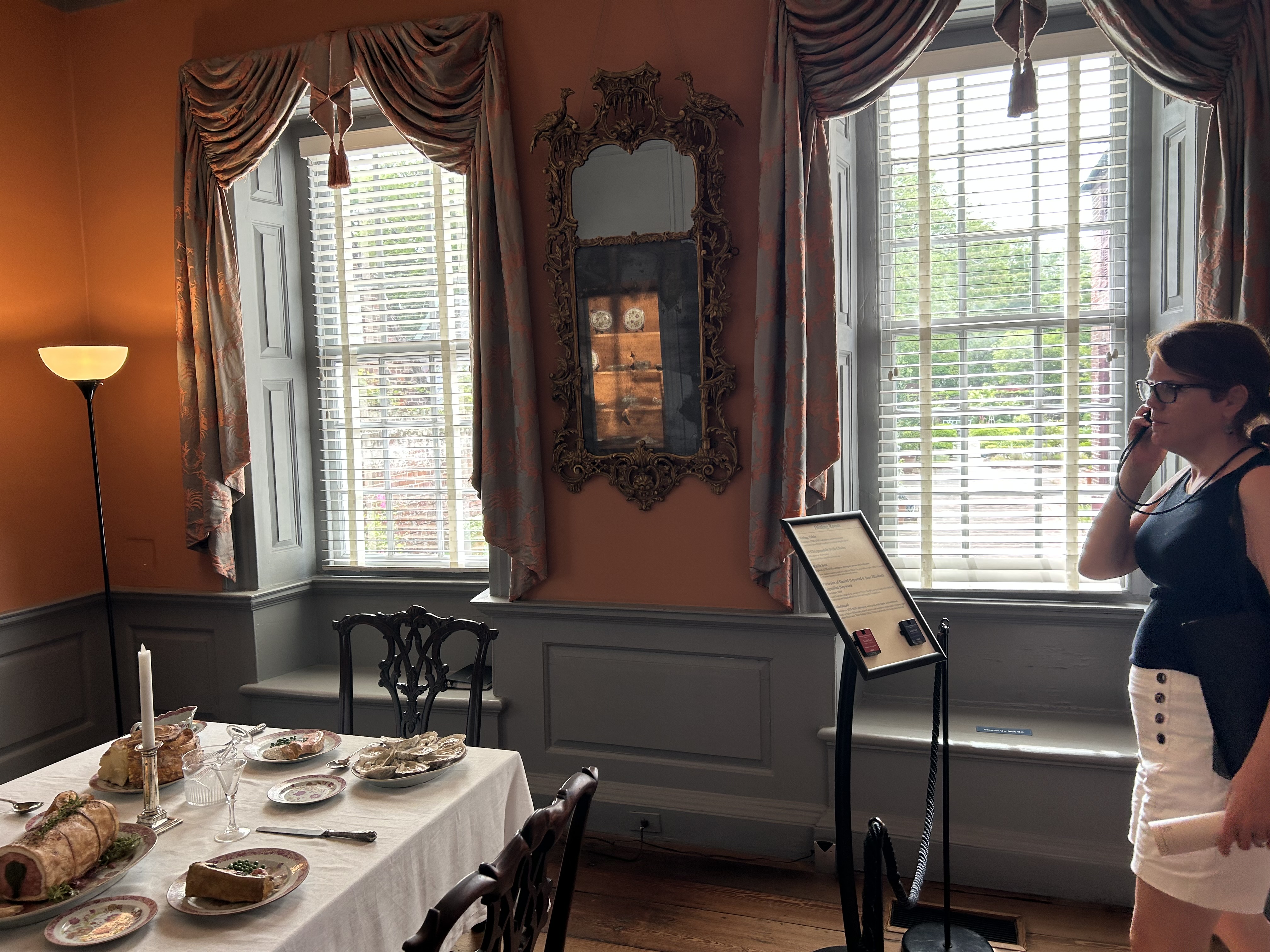
The Heyward-Washington House became Charleston's first historic house museum in 1930 after being acquired by the Charleston Museum in 1929. It was recognized as a National Historic Landmark in 1978. Two of the Heyward-Washington House's dramatic features are exclusive to Charleston house tours. It is located far from the madding crowd of tourism just south of Broad Street in a quiet section of the Lower Peninsula on Church Street.

Thomas Heyward Jr was one of four South Carolina signers of the Declaration of Independence and an artillery officer with the South Carolina militia in the Revolutionary War. He built his Georgian-style double house in 1772. However, he was captured by the British in 1780 when they took possession of the city and returned in 1781 by way of an exchange. In May of 1891, the city rented the house for George Washington's use during the President's week-long Charleston stay. Thus, it is recognized as the Heyward-Washington House, even though it was purchased from Heyward by John F. Grimke in 1794.

A black sign bearing its name marks the address. Standing at its large, Colonial-style pediment front door, a note requests you to knock. The host welcomes you to step into its large center hall which leads to the room where you either pay for the tour ($15) or present your pre-paid voucher. The tour is a self-guided audio presentation, and you can begin anywhere you want. The audio tour includes a recognition of the contributions of Lowcountry women and the enslaved.

You will see a superb collection of historic Charleston-made furniture as you leisurely stroll from room to room including the priceless Holmes Bookcase, considered one of the finest examples of American-made colonial furniture. The audio device details how each room had a specific use to the family combined with a story from the life of the Heyward family in that particular room. Recovered artifacts are displayed throughout. No surprise, in one of the rooms, you will see a portrait of its famous guest, George Washington, hanging above its fireplace.


The highlight of the tour, in my opinion, is when you step out the back entrance. It is here you will see the two dramatic features exclusive to Charleston house tours--the only 1740s kitchen building open to the public in Charleston as well as formal gardens featuring plants commonly used in the South Carolina Lowcountry in the late 18th century. The carriage house and kitchen building flanked each side with the spacious, beautifully landscaped garden extending beyond to the estate's farthest edges. I was surprised how far back it went. It was interesting to see the wide variety of utensils used in the kitchens and what meals were prepared for Thomas Heyward and guests. There is still an active archeological dig underway in the gardens.


The Heyward-Washington House offers an interesting and informative step back to Charleston's colonial days during and after the Revolutionary War for $15. However, several options are available for purchase. You can combine this tour with tickets to the Charleston Museum for $22 or combine it with tickets to the Museum and a tour of the Joseph Manigault House for $30. Tickets are valid for one year after purchase date. For the options, go to Charleston Museum.

87 Church St, Charleston, SC

Monday-Saturday: 10 am -5:00 pm (last audio tour at 4:15 pm)

Sunday: 12:00 - 5:00 pm (last audio tour at 4:15 pm)

Tuesday, February 7, 2023

The Captain's Tour Aboard the U.S.S. Yorktown by Bulldog Tours--Excellent Guide and Narration

While you cross the impressive Ravenel Bridge spanning the Cooper River that separates Mount Pleasant and Charleston, it is impossible to miss. Anchored in the riverbed mud some 20 feet, it towers over the passing tidal currents like an immovable colossus. As a matter of fact, the only threatening force able to move it was Hurricane Hugo, which put a slight lisp in its profile. It has been a centerpiece of Patriots Point since 1975. It is the National Historic Landmark called the U.S.S. Yorktown, an Essex-class carrier of World War II.

Viewing the U.S.S Yorktown from the Cooper River bridge as you pass by in a car doesn't do it any justice. Stand on the pier just below its gaping entrance, and you experience the full scope of its massiveness. However, scale the broad, steel steps and enter its interior, and you will feel like you were just swallowed by a gigantic iron whale. Numerous antique aircraft spanned the total length of the main deck to the right, and to the left, a museum with a restored B-25B Mitchell medium bomber used in the Doolittle Raid on Tokyo just beyond.

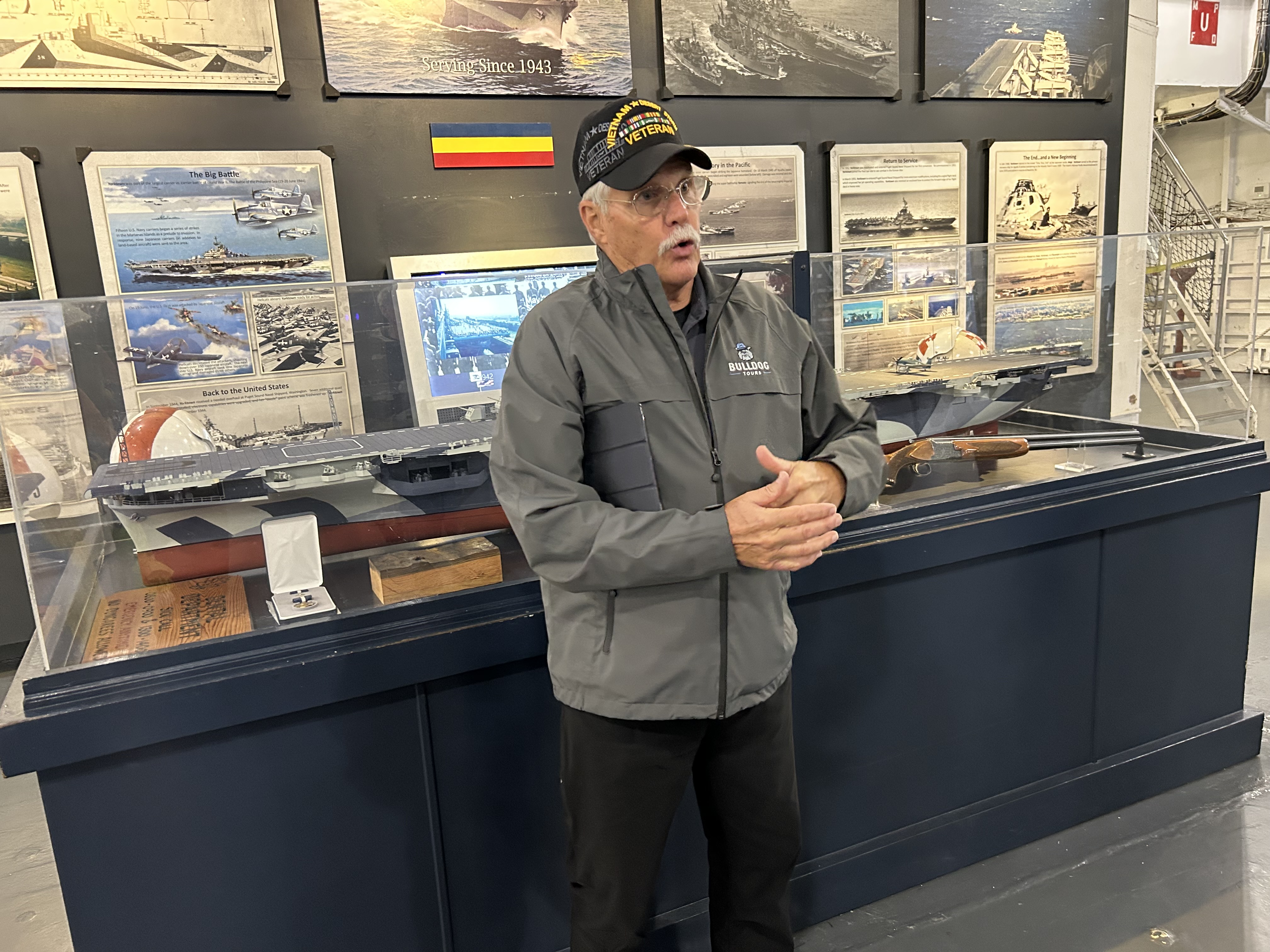
We had reserved the Captain's Tour: Steel Canva offered by Bulldog Tours. We checked in at the Information Booth and waited for our guide. There would end up being six people altogether in our group--a very manageable number. Upon arrival, the guide introduced himself and stated his credentials, along with a few humorous statements bunched in to lighten things up. A retired Navy man, Tom Simons had served on several ships as an aviation mechanic. His gentlemanly and personable demeanor was accentuated by a striking military stature.

He led us to a replica of the U.S.S Yorktown housed in a glass case, where he began a detailed history of the ship from its beginnings to its decommission and finally ended up stuck in the mud of Charleston's Cooper River to serve as a Naval and Maritime Museum. He also talked about the ship's first captain, Joseph James "Jocko" Clark--the first Native American to serve in that capacity.

Next, he made a brief stop to highlight a museum dedicated to Medal of Honor recipients and their stories--not a part of the tour but could be viewed anytime before or after. We took a short walk from the museum to the restored B-25 bomber used in the Doolittle Raid, where pictures of the 16 crews that partook in the raid and their stories lined an adjacent wall. We were afforded the opportunity to step aboard the display's bomber called the Ruptured Duck--a unique feature of this tour.


We now descended into the ship's guts to the crew's quarters, torpedo arming area, the galley, food preparation, dental offices, and medical quarters. A highlight was a stop at a drinking fountain, where the guide detailed the story that gave birth to the word "scuttlebutt."

We left the lower decks and trekked across the main deck to ascend several flights of steps at the very front of the ship to where the ship's huge anchor was stored, called the fo'c'sle or anchor room--each link of the long chain weighed 130 pounds with color coding positioned at various points of its length. From the anchor room, our group entered the upscale Captain's Quarter. Pictures of celebrity Ann Margaret, who once stayed on the Yorktown, hung on the wall. From there, we moved to the command centers and the flight deck, which was the end of the tour.


The tour was a total success, and that was because of our tour guide. He made it entertaining and enthralling. He spoke to each of us personally even though we were a group of six. His narrations were a balanced blend of facts and humor. As to the ship, it speaks for itself in many ways as you get an eyewitness look at its splendor and a glimpse into what it was like to live and serve on its decks. You get access to some things self-guided patrons do not on this tour. It is two hours long.


Photographs contributed by Anne-Merle Bryant

Adults: $42

Child (4-12): $29

Senior: $34

Military: $36

3 and under free

Bulldog Tours, 18 Anson Street, Charleston, SC

Monday, April 11, 2022

Charleston's Tradd Street and Simmons' Alley--A Charleston Lady with Unfulfilled Expectations

The pillars at the entrance to the townhouse
This is a true Charleston tale. Maybe you have already heard it while on a tour in Charleston or while reading one its many books or maybe you are hearing it for the first time. Simmons' Alley is more than just a tale because the names are real and the homes and plantations the people lived in are real.

However, the truth of this story lies somewhere between certainty and uncertainty. The reasons why have been often speculated, but never verified. A situation that was agreed upon by both from the very beginning. Attempts have been made to fill the void between certainty and uncertainty. One explanation has prevailed. I begin with the tale. 

The townhouse in this story is long gone, but people believe the long, narrow alley on Tradd Street with an entrance marked by tall, brick columns is haunted. It is said, during the late hours of the night, the pounding of horse's hoofs and the rumbling of coach wheels can be heard passing on this section of the street and down the dark alley. The carriage is carrying one occupant. The narrow pathway is called Simmons' Alley.

The two main characters are a Charleston lady with unfulfilled expectations and a Southern gentleman who would become a victim of an honor system void of mercy, both imprisoned by social norms of the cruelest nature. Ruth Lowndes Simmons was her name, and this is their journey into the dark side of self-serving love.

Ruth was the daughter of Rawlins Lowndes, an American lawyer, politician, and president/governor of South Carolina in the 1700s. She was in love with a childhood friend and John's Island planter named Francis Simmons. Over time, Ruth made the unwitting mistake of introducing Francis to her closest friend, Sabina Smith. Francis fell in love with Sabina immediately.

In a desperate move to counteract this unintended turn in fortune, Ruth conceived a plan incorporating deception. She told Francis Sabina was planning on announcing her engagement to another gentleman by the name of Dick Johnston. Heartbroken, Francis stepped aside.

Francis showed a handkerchief with his initials on it during a visit to Ruth sometime later and said, "Wouldn't you like to have such beautiful initials?" Ruth took that as a proposal. Next, Rawlins Lowndes called Francis to his home to discuss the proposal. Assuming Sabina would never be his wife, Francis accepted and made arrangements for his marriage to Ruth.

The wedding was now one day away, and Francis was walking down Church Street, which took him passed the Smith house and a happenchance rendezvous with Sabina. Ruth's deception comes to light during their resulting conversation. Sabina told Francis she never intended on marrying Dick Johnston. She entertained the hope that one day she might be his bride. Now those hopes were dashed, for tomorrow was his wedding day.

Outraged by what he now knew was a lie, Francis confronted Ruth Lowndes. The argument was the talk of Charleston. He expressed his contempt for her while she sobbed and pretended not to know what he meant. Raised an honorable southern gentleman, he resentfully honored his word and stuck to the agreement, thus losing Sabina forever. Bitter about the trickery, he told Ruth she would be his wife in name only.

November 15, 1796, was the date of their wedding. The place was the home of Ruth's father. Francis arrived late to the ceremony. As they exchanged vows, he didn't even look at her nor did he kiss her. He maintained that cold behavior throughout the reception. After the reception, they went to their new townhouse at 131 Tradd Street, purchased by Rawlins Lowndes as a wedding gift. Francis escorted Ruth to the door, told her with icy politeness that he hoped she would find the accommodations to her liking, and then departed to his plantation on John's Island, where he stayed for the next five years, seldom coming into Charleston.

Then, he purchased the property at 14 Legare Street and built the house that would later become known as the "Pineapple Gates House." His continued vengeance was unspeakable. He would show up for his estranged wife's dinner parties, sit at the long dining table opposite her but never spent a single night in her company. He lived in his house on Legare Street until his death twenty years after marrying Ruth, leaving their union unconsummated.

Charleston's long history provides the ideal plots for stories like this one, and its streets and alleys offer the perfect backdrop. You can choose from a variety of tours offered by the numerous hosts located throughout the historic Charleston Peninsula. Before or after your selected tour, be sure to make a stop at the Market Pavilion Hotel on E Bay Street and order the ghostly drink called the Nitrotini.

Tuesday, December 21, 2021

The Riddle of the Holy City

See the mark others may not, it's on the wall
Do you believe yourself to be good at solving riddles? If you do, I challenge everyone from Edisto Island to Cape Romain to solve this Holy City riddle. If you think yourself not to be, take a shot at it anyway. You will be surprised. It is a riddle of the ages with a prize at the completion of a successful journey buried just below the surface at the final marker in a capsule. It won't be an expensive ruby or a golden owl, but it does have monetary value.

Whether you be a resident or a Lowcountry visitor, the challenge will be an enjoyable hands-on quest to some of Charleston's most cherished sights, where you must collect vital information by way of embedded clues needed to take you all the way to the secret location. I am aware there are people who have an extensive knowledge of our charming city over others who may be new to the area. The equalizer, I believe, is the clues. They make it a level playing field for everyone.

Many of the riddle's puzzling verses, such as the "ghostly drink," "the telling ball," "the door goes round and round," "an iron gate of ebony," and others can be found in my books, The Charleston Lowcountry: Soak in the History - Bask in the Amenities  and The Town of Summerville: Soak in the History - Bask in the Amenities, now on Amazon.

Charleston is brimming with stories full of mystery, intrigue, and historical importance. Whether fact or fiction, they are an integral part of its persona. They breath life into every brick, plank, cobblestone, and iron gate that have been fused together into the mass of buildings and homes that form today's Holy City. They are spouted from every corner and doorstep. They are inescapable as their mosquitos once were.

People no longer come to Summerville to escape the oppressive heat and voracious mosquitoes of the coastal lowlands or for the cooling touch and healing scent of its sacred pines. Today, people come for its charm, its southern hospitality, its sense of community, and its rich history. A history as colorful as the town's famous azaleas and refreshed with the lifting of every flavorful glass of sweet tea.

So, challenge your wits and at the same time, have some fun doing so. "May the force be with you and the odds be ever in your favor."

Opening photograph: This famous wall is located on Legare Street. It is etched with the colors of history. On your journey through Charleston, stand before the wall and immerse yourself into its diverse textures, knowing its patterns just could help you see what others may not.

Monday, October 25, 2021

The Spellbinding Story of Charleston's Famous Unknown Resident

In the grand sweep of American history, few names echo with as much intrigue as Aaron Burr—a vice president, a duelist, a man etched into the nation's collective memory. Yet behind his infamous legacy lies a quieter, more haunting tale, one that drifts like sea mist through the cobbled streets and salt-stained air of Charleston. It belongs to his daughter, Theodosia Burr Alston, whose life and mysterious disappearance have become part of the Lowcountry’s whispered lore. Her story, though often overlooked, is as compelling as any found in the annals of early America.

Did this rendering give you a chill? The following true account is so chilling that after reading it you will exclaim, "Burrrrrrr." It is a story that has no resolution and to this day, remains a famous unsolved mystery. The characters are well-known historical figures with a Charleston connection. It involves the tragic disappearance of Theodosia Burr Alston.

Theodosia was born June 21, 1783. Her father was the third U.S. Vice President, Aaron Burr and her mother was Theodosia Bartow Burr. She was schooled on a curriculum meant for a future scholar, fluent in several languages, and equipped to handle herself in just about every subject, from math to music. Unfortunately, she struggled with intense bouts of grief after her mother died when she was eleven years old. In 1801, she married Joseph Alston, a wealthy landowner from South Carolina and a person known for a having a kind and caring demeanor. They lived at 94 Church Street, a fine house built by Thomas Bee in 1730.

94 Church Street

Theodosia was very devoted to her father and corresponded often, their letters numbered in the thousands. Her life grew more difficult in 1804 when her father fatally shot former Secretary of the Treasury Alexander Hamilton in a duel in Weehawken, NJ on July 11. Aaron Burr went on trial for murder with her full support and was acquitted. In 1807, he defended himself against a conspiracy charge and again she fully supported him. During this time, she traveled back and forth between Charleston and New York. After a year long, difficult trial, her father once again won acquittal, but due to opposition, left the United States for exile in Europe.

Theodosia returned to South Carolina. She remained a strong advocate for her father, writing letters to Secretary of the Treasury Albert Gallatin and to Dolley Madison in an effort to secure a smooth return for her father to the United States. The date for his return was set.

Theodosia's health had become more fragile, and when her son died of malaria in June 1812, she collapsed. She wrote her father, "Less than a fortnight ago your letter would have gladdened my soul. Now there is no joy, and life is a blank. My boy is gone-forever dead and gone!"

Aaron Burr returned to New York after four years of exile. He looked forward to seeing his pride and joy. Deeply concerned about his daughter's health, he convinced her to come to New York for the holidays. The United States and Great Britain were now at war. Her husband was sworn in as governor of South Carolina on December 10 and couldn't leave. Her health continued to deteriorate.

Alston was uneasy about sending her on what would be a five to six day voyage by ship. Adding to his concern were rumors circulating around the Carolinas about pirates operating along the North Carolina Outer Banks. Theodosia begged her husband to allow her to reunite with her father and after certain conditions were met, he consented. Alston wrote a letter to the British Navy blockading the coast, asking for safe passage for his wife and a doctor and close friend of Burr named Timothy Green was assigned to accompany her.

Theodosia, carrying a recent portrait of herself that she intended to give her father as a Christmas gift, Dr. Green, and a maid climbed aboard the schooner Patriot moored in Georgetown and set sail on December 31, 1812 into the dimension of both shadow and substance and crossed over into the Twilight Zone. The Patriot, crew, and passengers disappeared without a trace into oblivion. Thus, the chilling tale of Theodosia Burr Alston was born.

Joseph Alston wrote letters seeking information on whether his wife had safely arrived, only to receive the devastating news. Her father, Aaron Burr, accepted the theory the ship sank to the bottom of the Atlantic in a raging storm that battered the coastline on January 2 and 3 near Cape Hatteras, but rejected the astounding rumors of the legendary kind that circulated and morphed with the passage of time into today's legend.

Wild stories were theorized. Some claiming pirates, such as Dominique You aka "The Bloody Babe," took over the ship and made every passenger walk to plank. Others say Theodosia was captured, taken prisoner and transported everywhere from the Caribbean to Texas.

Then, there is the tale of the portrait, discovered in Nags Head on the Outer Banks of North Carolina in the 1860s, that many believe to have been the very one Theodosia took with her to be a Christmas gift for her father. While never verified, it's owner claims it was salvaged from a shipwreck that washed ashore on the barrier islands.

Yet, another story claims a Karankawa warrior came upon the wreckage of the Patriot and a dying white woman, who gave him a gold locket bearing the inscription "Theodosia" and told him that if he ever met white men, he was to show them the locket and tell them the story.

Legend has it her ghost is eternally chased by three pirates on the shores of Bald Head Island as she still frantically searches for a way to escape. Some versions even say those pirates are headless, beheaded for their incompetence in guarding her. In recent times, she is seen dressed in a flowing emerald-green gown, but most of the time she's dressed in all white, the outfit she is said to have slipped into before pirates made her walk the plank.

Some late December evening, you are walking on the Battery's waterfront after enjoying a dinner at one of the downtown's fine restaurants. At some point, you stop to look out over the darkened harbor waters. Suddenly, you feel a chill in the already cool air. Then, you realize you are not alone. In the corner of your eye, appears a figure. You turn and see it is a petite young woman dressed in a full-length white dress wrapped in a soft haze. You try to convince yourself the strange aura could be the result of the moonlight. You sense she is distressed. Out of concern you inquire, but she offers no response. You perceive she wants to be left alone and you move on. When shown a photo of the Nag's Head portrait, witnesses say they believe Theodosia is the woman they saw staring into the harbor. It was an unusual encounter to be sure.

Ghost Walk Tours

Charleston Tours

Ghost Walking Tour and Pub Crawl in Haunted Charleston

Narrated Haunted Ghost Cruise of Charleston Harbor

Thursday, September 2, 2021

Charleston Treasure Hunts-Join the Chase and Test Your Problem-Solving Skills

A wall at 8 Legare Street, the Sword Gate house
Charleston and the surrounding Lowcountry is full of legends of lost treasures. $63,000 in gold and silver is believed to be buried on or near the Hampton Plantation. Drayton Hall was occupied by the British during the Revolutionary War. Supposedly, a few buried treasures are in the area. A large quantity of Spanish treasure is thought to be buried near Cape Romain. The notorious pirate Blackbeard, may have stored treasures on Daufuskie Island. Pirate Stede Bonnet, who was hanged in Charleston, is said to have buried treasure along the banks of the Santee River.

However, hunters beware, packing a sense of humor along with your snacks is a must as seen in the following example. An old treasure chest brimming with what looked like silver and gold coins was unearthed by a jubilant woman with a metal detector on a Hilton Head beach. Surprise. They turned out to be toy coins. Nonetheless, treasure hunting can be fun and rewarding, whether the pursuit is authentic or invented for entertainment.

If you can solve this French riddle, you could win a Golden Owl statuette worth half a million dollars. Sur la trace de la chouette d'or (On the trail of the golden owl) is the title of the book created by Max Valentin, Régis Hauser's pseudonym name. It contains eleven double-page spreads, each of which is a discrete riddle composed of a title, text, and a painting. Each pair of pages is numbered with a wavelength associated with its colors, and with an owl face.

Michel Becker painted the eleven paintings for the book and also created the replica owl made of bronze, which was buried somewhere in France by Hauser on the night of April 23, 1993. Solve the treasure hunt, unearth the replica, and exchange it for the real Golden Owl made of gold and silver with a hundred diamonds embedded in the owl's face. 

The treasure hunt was launched on May 15, 1993. As of the present, it has not been solved. It is the second longest-running contest in the armchair treasure hunt genre. Of course, you will have to go to France to participate. I included this because of Charleston's strong French Huguenot history.

It is similar to the treasure hunt in the United States created by Byron Preiss in his 1982 book called The Secret, A Treasure Hunt, which also has not been completely solved.

In 1982, Byron Preiss buried twelve treasure boxes in secret locations in twelve cities. He commissioned twelve mesmerizing paintings to be created containing clues for the seeker to decipher. The book was authored by Sean Kelly and Ted Mann and illustrated by John Jude Palencar. The ornate boxes were hidden on city property, in local parks, and possibly in your own backyard. Ironically, Charleston is believed to be one of those chosen cities.

Each box contains one of twelve keys. If you solve the clues and retrieve the key, the prize you receive is the jewel accompanying the artwork. You are instructed to send the key to the author and in exchange, he would send you the valuable treasure. There is over ten thousand dollars worth of precious jewels. So far, three have been discovered in Chicago, Cleveland, and the most recent, Boston. Nine remain undiscovered.

Strangely, both Regis Hauser and Byron Preiss were killed in car accidents. Hauser left the solutions to his treasure hunt inside a sealed envelope, which are now held by his lawyer. Preiss kept no record of the treasure boxes' exact locations, but his estate has chosen to honor his endeavor.

Charleston is believed to be one of Preiss's chosen cities. One of the mysterious paintings unmistakably contains a map of what looks like an outline of the Charleston peninsula and surrounding landscape. Josh Gates of "Expedition Unknown" came to the Holy City in May of 2019 to film a dig that would take place near Charleston's Defenders of the Confederacy monument. It was believed the clues had been solved and pointed to that location, but the attempt failed to reveal the ornate treasure box. Can you solve it?

You have the opportunity to participate in another Charleston treasure hunt. Blue Steel Promotions, On Purpose Adventures, and On Purpose Games have teamed together to sponsor the biggest and most epic scavenger hunt the Holy City has ever seen called The Hunt: Charleston. It will take place Saturday, November 13, 2021, from 10 am – 9 pm. The grand prize is an all-inclusive trip to Cancun for 5 days. Tickets are $85 - $150.

Teams of four will be pitted against the clock, the elements, and the competition to accrue points and solve clues to be the first to find the buried treasure. They will face tasks and challenges of all types including physical activities like kayaking, skateboarding, handstands, human pyramids, and wheelbarrow races. Other activities will be solving puzzles, riddles, anagrams, brainteasers, decipher cryptic codes, augmented reality, and more.

There will be a Welcome Party Friday night where you'll pick up your "welcome packet", meet and mingle with fellow competitors while enjoying drink and food specials. The weekend will wrap up with an After Party at a restaurant/bar close by the treasure site. Location will be revealed at the finish of the hunt. For full details, go to The Hunt: Charleston.

In addition, I invite you to be the first to solve the accompanying clues with a prize on the completion of a successful journey. It won't be an expensive ruby, but it does have monetary value. If you love the Holy City, it will be an enjoyable hand-son quest to some of its most cherished sights where you must collect vital information by way of challenging clues needed to take you all the way to the secret location. A capsule is buried just underneath the surface with instructions inside.

Check out my recently released book on Amazon, Charleston and Summerville, South Carolina, Soak in the History-Bask in the Amenities. It talks about "the chilling ghostly drink," the "telling ball," and much more. Enjoy Charleston and have fun, my friends.


More Charleston Treasure Hunts:

Sunday, August 1, 2021

The Riddle of the Holy City--See If You Can Solve It for the Prize

Do you believe yourself to be good at solving riddles? If you do, then this article is for you. However, if you think yourself not to be, take a shot at it anyway. You will be surprised. It is a riddle of the ages for you to solve. It is in the spirit of one of the most interesting books ever written called "The Secret."

"The Secret" is about a treasure hunt devised by its author to take its readers on a journey to cities in the United States and Canada, to enlighten them on events and people that played significant roles in the genesis of the New World.

In 1982, Byron Preiss buried twelve treasure boxes in secret locations in twelve cities. He commissioned twelve mesmerizing paintings to be created containing clues for the seeker to decipher. The ornate boxes were hidden on city property, in local parks, and possibly in your own backyard. Ironically, Charleston is believed to be one of those chosen cities.

Each box contains one of twelve keys. If you solve the clues and retrieve the key, the prize you receive is the jewel accompanying the artwork. You are instructed to send the key to the author and in exchange, he would send you the valuable treasure. There is over ten thousand dollars worth of precious jewels. So far, three have been discovered in Chicago, Cleveland, and the most recent, Boston. 

Preiss was sadly killed in a car accident since, but his estate has chosen to honor his endeavor. You can purchase his fascinating book in which you will find the 12 images and 12 verses along with an unusual and fanciful story about the Fair People on Amazon and several other outlets.

So, lets challenge your wits and have some fun doing so at the same time with a little incentive. I invite you to be the first to solve the accompanying verses with a prize on the completion of a successful journey. It won't be an expensive ruby, but it does have monetary value. If you love the Holy City, it will be an enjoyable hand-son quest to some of its most cherished sights where you must collect vital information by way of challenging clues needed to take you all the way to the secret location. A capsule is buried just underneath the surface with instructions inside.

I know there are individuals who have extensive knowledge of our charming city over others who may be new to the area, so we will see how you fare. The equalizer, I believe, is the clues. They make it a level playing field for everyone.

Check out my recently released book on Amazon, Charleston and Summerville, South Carolina, Soak in the History-Bask in the Amenities. It talks about "the chilling ghostly drink," the "telling ball," and much more. Enjoy Charleston and have fun, my friends.

Wednesday, December 30, 2020

In Charleston, the Truth Lies Somewhere Between the Cooper Sunrise and the Ashley Sunset

Charleston's antiquity runs as deep as its harbor waters and its tales are as tall as the steeple of St. Phillips on Church Street. As one of the oldest cities in America, it is a place where reality and legend walk the same streets declaring a timeless story about the lives of its progeny and their hallowed structures. A place where fact and fiction have been skillfully blurred to the delight of those who come to bask in its charm and grace. This article is about some things you will hear on a horse-drawn carriage ride or walking tour that simply is not likely to be true.

Over the course of 300 years, the Pink House has proven itself resilient. It survived over thirty hurricanes, two major earthquakes, two wars, and multiple catastrophic fires. It has a must-see courtyard designed by Loutrel Briggs and a picture-perfect view of St. Philip's steeple through a window.

Like many old Charleston landmarks, it has acquired a ghost story or two. The apparition sighted and from time to time photographed, is that of a female figure wandering and pacing back and forth as though waiting for something or perhaps someone. Some believe the sightings are the spirit of one of the women who once worked at the property during its tavern and bordello days, and others believe it to be the ghost of the female pirate Anne Bonny. According to the narrative, she resided on the third floor and ran a popular business on the floors below. There are several variants to the story of Anne Bonny. The following tale is the most popular.

Born in Ireland, the red-headed Anne is believed to be the illegitimate daughter of attorney William Cormac and his housekeeper. To escape the backlash the sordid situation created, Cormac left Ireland with his mistress and his daughter. They sailed to Charleston.

Anne was a handful for sure and had a fiery temper. While married to James Bonny, a small-time pirate and informant, she became involved with Calico Jack Rackam. To avoid a beating by her husband because of her affair, she ran away with Rackam and joined his pirate crew on a ship they stole in New Providence called the William.

Mural at Pirate Cove Playground, Folly Beach
In 1720, Jonathan Barnet attacked Rackam's ship and took him prisoner with Bonny, Mary Read, and the rest of the crew. The punishment for piracy in the 18th century was execution by hanging. One by one, her friends perished, including Calico Jack, but Bonny and her close friend, Mary Read, pleaded they were both pregnant. The court spared Bonny and Read from hanging like the others. She began to serve her prison sentence and gave birth, but there is no record of Bonny's release, execution, or death. This has fed speculation as to her fate.

After everything has been searched and said, a Post and Courier article, The true and false stories of Anne Bonny, pirate woman of the Caribbean, summed up Anne Bonny's story this way, "Nearly three centuries after Anne Bonny's trial, we know that a woman named Anne Bonny was alive in the early 1700s, that some people called her Ann Fulford and Bonn, that she lived in the Bahamas for a time and joined a pirate crew."

"We don’t know whether she ever lived in Charleston, who her parents were, whether she married a man named James Bonny, her true role aboard the pirate sloop, what her relationships were with Jack Rackam and Mary Read, and whether she ever was released from the Jamaican prison." Often times, the legend becomes larger than life. In Charleston, the truth lies somewhere between the Cooper sunrise and the Ashley sunset.


This is true of one of Charleston's oldest townhouses located at 143 and 145 Church Street. It was built by Huguenot merchant Alexander Peronneau as a double tenement around 1740, likely after Charleston's great fire of 1740. The material used in its construction was Bermuda stone placed on a brick foundation. Bermuda stone was widely used in the construction of early Charleston. The city's old fortification wall was made from Bermuda stone, as was the 1769 seawall, which was probably destroyed in the 1800s by a hurricane.

In the late eighteenth century, the double tenement was owned by craftsman and planter Paul Smiser. Next, Mrs. Goodwyn Rhett took possession of the property. In 1928, Mrs. Rhett restored the home to a single residence with Thomas Pinckney's help, a local African-American builder. Outbuildings located behind the primary residence were constructed using salvaged brick from the former Shepheard's Tavern on Broad Street, also called The Corner Tavern, which was demolished in the same year.


It is believed, after the restoration of the house, rumors began to circulate claiming pirates lived there in its early days and used an underground tunnel system located in its basement that was connected to the waterfront of the Battery. The rumors stated the tunnels were the primary means of smuggling and escaping by the pirate visitors. During extensive renovations and the redirection of Charleston's sewage systems in the 1930s, the tunnel was filled with sand, as the story tells.

One rumor claims Blackbeard's legendary cache of gold is buried somewhere within the tunnel or in the basement of the house, which remains highly suspect because facts lean toward the presumption Blackbeard never set foot on the Charleston peninsula. As to the assumption pirates stayed there, Charleston's pirate days had ended by 1720. Although, sailors could have stayed at the tenement. However, search as you may, no legitimate evidence has been found to support such claims.

It is hard to say with any surety who visited the double tenement at 143 and 145 Church Street and what happened there. The name Pirate House became attached to the address due to the undocumented stories. Despite contrary facts, it will forever be known as the Pirate House, and the rumor will prevail with those who choose to believe. And to those who choose otherwise, in Charleston, even the truth is legendary. The house at 37 Meeting Street has similar stories.


The single house is an architectural style found almost exclusively in Charleston. The design is responsible for much of the city's unique charm. The floor layout was perfect for the narrow street-facing lots originally laid out in Charleston in the late 17th and early 18th centuries.

The single house is only one room wide and two rooms deep on each of its levels with a central hall between them. They were purposely built with the piazzas facing south or west to get the cooling, prevailing breezes from the sea. It runs the length of the house with a public door facing the street at one end. Visitors would enter the home through this street entrance and traverse the porch to the home's centralized private door. Entertaining was done on the second floor, further from the dust and noise of the street.


While walking or riding the historic streets of the city, a tour guide might tell you single houses were a reaction to the city taxing street frontage, but truth be told, it had more to do with the efficient use of limited real estate in the confines of a peninsula. A Charleston County Public Library article entitled The Charleston Single states, "Early Charlestonians developed the single house as an ingenious solution to the various demands of their unique urban landscape: a house that provided privacy, ventilation, fire protection, and social status within the confines of a tightly restrictive public space."

Tuesday, July 26, 2016

Dolphin Discovery Sunset Cruise With Barrier Island Eco Tours--A Relaxing Cruise To A Timeless Charleston Wonder

There were storms in the area, but from my experience, the sun always shines on the Isle of Palms. As I crossed the Daniel Island bridge, I could see the rain falling out over Charleston, but looking to the direction of the IOP my belief was confirmed--blue skies filled the horizon. I was traveling to the Isle of Palms Marina where I would board Barrier Island Eco Tours 49 passenger pontoon boat called the Caretta for a two and a half hour Dolphin Discovery Sunset Cruise to Capers Island. It was scheduled to leave dock at 6:00 pm.

Upon my arrival, I checked in at Eco Tour's booth, received my parking pass and picked up a couple of snacks to take on the cruise. Since it was 5:30 pm, I had an half hour to kill. While I awaited the signal to board, I sat on the red stained, wooden deck of the market and soaked in the late-afternoon marina atmosphere and humid, salty air of this popular backwater gathering place overlooking Morgan Creek. From the size of the gathering and awaiting crowd, it was going to be a full cruise.

As we boarded the Caretta, Captain Mike warmly greeted me and every person that crossed the gang plank. I took an outside seat along the rails for optimum picture taking and was joined by two other cruisers. The declining sun was still quit hot. As the boat gently rocked in the creek's ebbing current, the tour's naturalist, Sarah, welcomed everyone aboard. She delivered some opening words and ended the introductions with, "So, let's get the air conditioning going." With that said, Captain Mike fired up the engines and we eased away from the docks. The slight back water breeze and forward motion of the boat offered a welcomed cooling reprieve.

As we slowly motored in the no-wake zone, everyone on board one-by-one shared their places of origin with Germany the farthest. Sarah talked about the meaning of a tidal creek and how the level of Charleston's estuaries rise and lower on an average of six feet and added, "It does that twice in a twenty-four hour period."


Our first stop, after leaving the no-wake zone, was a nearby tributary where Sarah employed the assistance of the younger cruisers in pulling up some of Eco Tours' crab traps marked by floating buoys. Each of them enthusiastically took hold of the attached rope and dragged the trap on board. The first trap came up empty, except for two spade fish. It seemed the crabs discovered a way of escape through a damaged section of the cage to freedom. However, the second trap offered up the desired prize. She pointed out the various names people identify the captured crab by, but in South Carolina, it is known as the blue crab--a Charleston delicacy. After a few facts about It habits and identifying its sex, we headed to the open waters of a area called the Shark Hole--a deep hole, approximately 90 feet, scoured out by the constant current flowing in and out of the Atlantic channel between Dewees Island and the IOP.

Sarah asked what wildlife we hoped to see on our way to Capers Island, and of course dolphin, the bottlenose variety, was on top of the list. After all, this was a dolphin discovery cruise. She related some particulars about the dolphin. For example, South Carolina estuaries are the only place you can view the feeding frenzy called strand-feeding. One other interesting tidbit I learned from her informative narrative was that the dolphin is a highly protected marine species in South Carolina. You are not permitted to feed, catch, or hold a dolphin in captivity. Not even the South Carolina Aquarium display dolphins in their numerous exhibits. "In the wild, they are neither afraid of you or interested in you," she stated.

"Other wildlife you may see on our way to Capers is the loggerhead turtle, the opportunistic brown pelican--known for diving face first into the water to scoop up its dinner or patiently waiting for the dolphin to stir up some lunch, and a variety of other birds," Sarah informed. We scanned the sparkling waters for something to break the surface of the water. The boats expert dolphin-spotter named Hobbs, a mixed breed dog, alerted the group, but the sighting was brief. It was now time to leave the Shark Hole and head to Capers. With a thrust of the engines and spray of salty water in my face, we headed to the south-end of the island.


It was low tide. The sand that is usually covered by water was now exposed making the beach more expansive. The subtle rays of the declining sun washing over the island's sandy beachhead gave the terrain a soft glow. Not too far in the distance, the grayed timber of Boneyard Beach rose out of the sand like bleached skeletons left over from the age of the dinosaurs. The dead trees are a testimony to the Atlantic Ocean's relentless erosive power. I walked under their barren branches and photographed their fallen monarchs. The walk back to the Caretta was even more inspiring. Posing on the horizon, brushed over with the orange tint of the skylines changing evening palette, the darkened silhouette of the Caretta awaited our presence for a relaxing ride back to the Morgan Creek docks to the music and panorama of the living IOP estuary.


Unless you own a boat or know someone who does, some of Charleston's more secluded natural wonders are out of reach. Barrier Island Eco Tours Dolphin Discovery Sunset Cruise to Capers offers you the opportunity to see one of them firsthand. The cruise aboard their Caretta is a relaxing evening jaunt to one of Charleston's most beguiling and picturesque barrier Islands. While you are enjoying the scenery, the naturalist on board shares with you their knowledge of what you are observing giving you a greater appreciation for the wildlife and the estuaries that make Charleston the number one destination in the world. Our naturalist for the evening delivered an informative presentation laced with a good balance of humor and included the younger ones in the activities. Somewhat disappointing, we did not see much in the way of dolphin activity. Possibly, it was the low tide, but that is the nature of things when it comes to wildlife in their natural habitats. It is a matter of timing. Capers Island did not disappoint. The low tide and setting sun enhanced the timeless beauty of the island's Boneyard Beach.


Offered Sunday-Friday from 6:00-8:30pm, Memorial Day through Labor Day.
Offered Sunday, Wednesday and Friday year round. Times vary with sunset.

$36 for adults, $26 for children 12 and under, 2 and under are free
Purchase tickets

Barrier Island Eco-Tours 50 41st Avenue
Isle of Palms, SC
843-886-5000