Friday, March 4, 2022

Summerville's Tour Guides and Tours Through the Years

Visitors were greeted by this overhead arch for over three decades in the early 1900s, welcoming them to Summerville. The brick archway meant "coming home" to travelers, as well as residents. Flanking both ends of the town's name was the phrase, "Flower Town in the Pines." When leaving, the last thing they saw was the town's motto, "Let the Pine be Sacred."

Since the early 1900s, tourists flocked to the town in early spring to enjoy millions of spring blossoms, particularly azaleas, in private and public gardens, including the mid-town Azalea Park. Thus, Summerville acquired the earned designation, "The Flower Town in the Pines."


The azalea spring bloom is just beginning. It is a prelude to the biggest festival in South Carolina, the Flowertown Festival. This year it is scheduled to take place April 1 – 3. Have you ever wondered how the name "Flower Town in the Pines" came to be?

In 1925, Virginia Lowndes Bailey entered a slogan contest sponsored by the town's Chamber of Commerce. She won the $5 prize. Her entry was "Flower Town in the Pines." The brick archway spanning Main Street near the Highway 78 intersection spotlighted her winning slogan for all to see. Virginia's son wanted her contribution remembered. She was known as "the horsewoman." So, the family donated a horse weathervane to the town, and the town council approved a commemorative plaque. The brick archway with her winning slogan is gone, but the weathervane remains and resides on top of the present Town Hall building.

In the 1930s, tour guides would stand by the brick archway holding signs in their hands, entertaining the hope arriving tourists would acquire their services. The Town Hall was another gathering place for the young guides. All local boys, upon being chosen, they would jump onto an arriving car's running board and direct the driver past the town's beautiful residential gardens and key landmarks. Berlin G. Meyers was one of those young boys. He was paid a meager five dollars for his services, but as he fondly recalled, "A real fortune for a young boy in those days." The brick archway crumbled into history, leaving fond memories of a bygone age.

In 2011, Summerville experienced a revival of its glory days when it embraced its identity as "The Birthplace of Sweet Tea." Mayor Bill Collins formed a tour task force in 2013 and tours in Summerville took on a new look in the shape of green and red colored transportation vehicles. They were seen traveling the streets around the downtown area and beyond on Fridays and Saturdays. In 2013 and 2014, sweet tea and tours put the town in the Lowcountry spotlight. As a beneficial result, the "Sweet Tea Trail" was formed, and the "Sweet Tea Festival" was established. A 15-foot mason jar named "Mason" stands in the downtown district, a testimony to the town's rights to the trademark.

The "Good Eats on the Sweet Tea Trail" was one of those tours. Immediately upon arrival to the Visitor Center doors, Tina Zimmerman, Summerville's tourism coordinator, graciously welcomed you. An offering of sweet tea was available nearby. Once everyone had arrived, the group assembled in a room lined with images of Summerville's past. Tina began the tour with an inspirational video introducing everyone to a short summation starting with the town's inception and concluding with Bill Collins, Summerville's mayor, wishing all a fun time. Storyteller Tim Lowry, as guest narrator, entertained the group after they boarded the trolleys. Summerville DREAM's Janyce Shoemake Hursey often accompanied the guests as the trolleys transported them to various local food entrepreneurs.

"Sweet Tea Trolley Tour of Historic Summerville and Linwood Gardens" was a 90 minute guided tour for $20 where you would see the preserved downtown and then travel through the back roads of the town to see its historic homes. Like "The Good Eats Tour," it started in the Visitor Center with a history film from 1939. Local historian Barbara Lynch Hill would give a guided tour on the trolley with a stop at the historic Linwood Gardens, named one of the 10 Best Bed and Breakfast Gardens in the World. In case of rain Linwood owner will board the trolley and give oral tour. A second tour concentrated on history, was more extensive and included the sites of the Tea Farm and The Pine Forest Inn.

Summerville DREAM planned on offering tour guide training for the "Sweet Tea Trolley Tours." Tim Lowery and Barbara Lynch Hill were assigned to conduct the sessions. The workshop was to be held at the DREAM office at First Citizens Bank. Unfortunately, the trolleys would eventually leave town.

Time rolled on for the town, and plans were brewing in the downtown area. On March 1, 2019, Summerville inaugurated the newly completed Hutchinson Square Project with a ribbon-cutting and celebratory party. Town representatives and residents packed the refreshed historic downtown area. The crowning touch to the restoration featured a pavilion with a roofline patterned after the old railroad station that once upon a time stood close by and a gateway reminiscent of earlier days in the town's honored history, a replica of the old brick archway. A proclamation went out declaring Summerville to be "AT THE HEART of it ALL."

The Visitor Center established the following tours to offer visitors and residents an opportunity to immerse themselves into everything Summerville today.

The Sweet Tea Trail: Created for visitors to fully experience Summerville as "The Birthplace of Sweet Tea," Participants will embark on the trail to explore the shops, sites, sips, and tastes that make life in Summerville so sweet. Trail Guides are available at the Summerville Visitor Center, at participating stops, or you can go to the Visit Summerville web page. Collect Stamps with the purchase and redeem Official Birthplace of Sweet Tea gifts and merchandise.

The Walking Tour of Homes and Flowers: A leisure one-hour stroll past 20 historic homes with a sign and QR code with information about each home. It begins at the Cuthbert Community Center in Azalea Park on West 5th South Street. Old homes framed by majestic oaks whisper their stories, and towering church steeples built a century ago recall the town's foundation. In Historic Summerville, no two houses are alike, and an afternoon spent with a cold glass of tea and a sense of adventure can reward you with a myriad of beautiful architectural visuals.

The Summerville Porch Stroll on the Sweet Tea Trail: The first porch stroll was inaugurated on June 12, 2021. This neighborhood and community event offers eight different porches where attendees can sit and sip iced tea on some of its most beautiful southern porches. With expected Summerville southern hospitality, each of the eight hosts offers unique delectables and experiences, including strolling historic gardens, farm animal snuggles, live music, and artwork by local artists available for purchase. The next one will be June 11, 2022. Proceeds benefit the Timrod Library.

Summerville is benefiting from a unique heritage that has been brewing since the early 1800s. The possibilities have become "sky's the limit." So, put out the southern welcome mat of hospitality and complimentary cup of sweet tea.

Wednesday, February 23, 2022

Is It True or Is It Not--The Phantom Flight Over Summerville

Former Sheep Island Road.
Most everyone loves a good mystery, and Summerville has its share of the unexplained. That is what drew hundreds if not thousands of young people to Sheep Island Road. The Summerville Light is by far the most revered of the area's eerie sagas whose nuances are deeply engrained into the persona of the town's Generation Xers and Millennials. Other well-known paranormal hotspots include the ruins of Colonial Fort Dorchester, the bell tower of St. George's Church, Guerin's Pharmacy, the E Doty Avenue house, the Quackenbush-List home, the Price House Cottage Bed and Breakfast, and Montreaux's Bar and Grill. However, there is one that ascends above all of these. The most controversial of the towns inexplicable takes you to the edge of the fifth dimension, the middle ground between light and shadow.

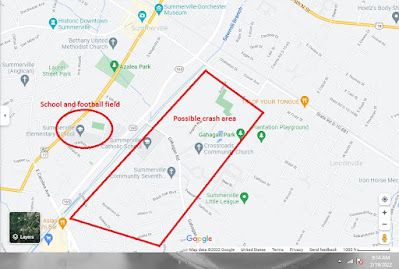
If the story is true, somewhere in the marked area of the included map is buried the structural remains of a World War II B-24 Liberator Bomber. It is a proposed location based on descriptions found in a beguiling narrative recorded in the book, Haunted Summerville, South Carolina. The author, Bruce Orr, recounts the event as told by two main eyewitnesses, Betty Jo Waring, a spotter on duty in the Town Hall bell tower, and Bobby Anderson, a student in a local school. Other eyewitnesses include fellow students, school faculty, and a crowd of townspeople. The details are as follows:

"Betty Jo watched it come in from the east. She saw parachutes begin to open in the sky one by one. Ten in all opened as the plane began to make circles...and as it flew over, she recognized the large bomber. It was one of ours. The plane was a B-24 Liberator Bomber...The plane began to level out. In his classroom, Bobby Anderson was staring out the window...It barely cleared the store across the street before clipping the treetops...it sputtered along the trees and disappeared...Bobby and his classmates jumped to their feet, raced across the classroom and out the door. They gathered on the football field with the other students and watched the little white parachutes drifting in the April sky...The young boys raced around the teachers and down the path...The boys reached the smoking wreckage and began scavenging souvenirs from the crash site before the authorities arrived...The townspeople lined the road on foot, on horseback, in wagons, and in cars as they hurried to the burning plane...Eventually, the town authorities showed up and extinguished the flames. The military showed up and retrieved what it wanted. Then the bulldozers showed up and buried the rest."

The incident occurred on April 4, 1945.

As you glean the story's passages, you notice the usage of landmark identifiers, such as Town Hall, treetops, a store, a school, and a football field. Also, there would need to be a unpopulated space on the edge of town large enough to accommodate a crashing bomber. A bomber armed with eleven .50 caliber machine guns, carrying a payload of eight sixteen-hundred-pound bombs, weighing in at about fifty-five thousand pounds, and possessing a wingspan of 110 feet. The section of town containing all those characteristics likely puts the crash scene along South Main Street and east just beyond Sawmill Branch.

South Main Street and the school.

The football field.

The store.

Mysteriously, a comprehensive search revealed no Charleston newspapers reported the crash, and that includes newspapers everywhere. The Air Force Historical Studies Office, which maintains records, historical data, and archives, officially maintains the ditching of a B-24 Liberator Bomber never occurred on that date in Summerville, SC. Secrecy was a key element during World War II, and censorship did not want that information to be broadcasted. The war ended September 2, 1945--put it in the X-Files along with Area 51 and the Devil's Triangle. It seems more than just a bomber was buried on that fateful day.

There are a few unexplainable chinks in the telling. According to the story, no one was in the aircraft at impact. All occupants safely exited via parachutes, which included the pilot. I find that difficult to accept. It would mean the pilot, at a safe elevation for deploying a parachute, abandoned his aircraft over a civilian population to crash where ever it may. Any responsible pilot would not have permitted that to happen.

No one knows what the plane was doing and why it ended up flying over Summerville. Speculation was it had been patrolling the coast searching for Nazi U-Boat submarines, but that would have been an assignment for a fighter more so than a bomber. Also, why didn't the pilot ditch the failing aircraft into the ocean, unless he lost total command of the primary flight controls and couldn't do so, but that hypothesis can be quickly dismissed since the pilot was still capable of circling the town.

Despite the notable chinks in the story, the named eyewitnesses Betty Jo Waring and Bobby Anderson cannot be ignored, not to discount a whole school of students and school faculty. Consulting the crew and pilot would be futile, they would be obliged to take an oath of confidentiality. One thing is for sure, the bell in the town hall bell tower would have rung out, thus alerting the firefighters and townspeople of the catastrophe. It served as a fire alarm for the town, indicating by a predetermined sequence of rings what part of town was on fire to direct the volunteer firefighters to the correct location.

Many years have passed since April 4, 1945. Still, there is possibly somebody out there who knows the truth. The question: Who are you, and are you willing to come forward and shed some light on this Summerville mystery?

Otherwise, mystery sleuths, get out your magnetometers and ground-penetrating radar equipped drones, there is a deeply hidden secret needing to be unveiled. This could be a venture requiring the expertise of Josh Gates and Expedition Unknown. Without a doubt, "The Phantom Flight Over Summerville" would make a good Twilight Zone episode.

Saturday, February 19, 2022

Middleton Place's Rice Mill--Once a Tea Room Managed by a Summerville Matron and the Digs for a Famous Southern Chef

Halcyon Place was the name of a Southern Style house on South Main Street owned by Mr. and Mrs. George S. Weed at this pivotal time in Summerville's history. It would become the Halcyon Inn during the town's Golden Age.

The inn was not known for accommodating famous guests like the Pine Forest and Carolina Inns, at least I am not aware of any. Framed by the property's groves of magnolias and oaks, its sprawling two-story white-columned porch was a welcoming reminder of space and calmness for its seasonal patrons. A strategically placed joggling board offered an amusing session of relaxing contemplation. If the moment was right and the sojourner willing, the inn's host would retell the endearing story of the fateful circumstances that brought the wooden apparatus to the house.

Mrs. Caroline Parameter, daughter of Mr. and Mrs. Weed, was well known for her delicious entrees. Mrs. Parameter also showcased her culinary expertise at the springtime Tea Room on Middleton Place for the Junior League of Charleston during the late 1920s. The Tea Room was the first of the Junior League's fundraising enterprises.

Middleton's rice mill, situated next to the butterfly lakes and the rice mill pond, underwent weighty alterations during its transformation into the "tea room." The revamped two-story building, topped with a mansard roof, offered a tranquil setting for sipping locally grown Southern tea and sharing meaningful Lowcountry conversation. In its second-floor kitchen, League volunteers prepared okra soup and made sandwiches that they served to guests seated at tables overlooking the Ashley River. The first-floor eating area, adorned by a fireplace and andirons, was outfitted with a dumbwaiter the staff used to transfer food from the kitchen.

The Tea Room remained in the Rice Mill until 1949 when it was moved to a new location and became the Middleton Place Restaurant. It was converted to a museum in 1956, featuring a spinning wheel and "Brown Bess" over the fireplace.

The Restaurant building was designed by W. Bancel LaFarge in 1933, based on research done in Barbados, and has the same roof lines as the Rice Mill. Originally used as a guest house, it had two bedrooms and a sitting room upstairs. The cypress-paneled room downstairs was a living and game room surrounded by a screened porch. The Cypress Room, now used as a private dining room, was originally a series of storerooms leading to the plantation office.

In 1985, the owners of Middleton Place persuaded Edna Lewis, one of the country's ten most influential women in the food industry and one of the founders of Cafe Nicholson on Manhattan's East Side, to join them with a goal to inspire a menu based on historical records of early Carolina plantation cooking. She took up residence in the Rice Mill and became their head chef and consultant.

Many ideas for Edna's menu came from a book called "The Carolina Housewife" published in 1847 by Sara Rutledge, a cousin of the Middletons. Although the recipes in the book are incomplete by today's standards, Lewis drew the essentials from them and developed dishes that the well-to-do Middletons might have eaten. Dishes like panned quail with julienne of country ham and spoon bread, rabbit pate, broiled oysters on the half shell with buttered crumbs, pan-fried flounder, watercress soup, grits, shrimp paste, whole strawberry preserves, chocolate souffle, and caramel layer cake.

There are two choices for seating at the restaurant, the dining room or the garden. The view from the dining room is stunning. Lined with large windows, it overlooks the old rice mill pond and picturesque Azalea Hillside. If available, the garden seating offers an intimate, quiet space with a view of the spacious field in front of the South Flanker.

Enclosed by a three-foot brick wall and draped overhead by Spanish moss, a variety of potted plants accented the space--a perfect setting for sipping on an afternoon sweet tea, or if you are feeling a little more fruity, a glass of wine.

Despite the varied menu, I kept it simple and chose the special of the day, a roast turkey sandwich topped with green fried tomatoes and field greens picked from their on-site garden partnered with a side of French fries--sublime.

The casual lunch was sufficient. I was at Middleton Place for its historic surroundings and the garden atmosphere offered by its restaurant. With the warm Charleston sun shining overhead, the setting was perfect for basking in the aura of an antique building and savoring a delicious meal under the shadowy canopy of an ancient oak tree.

In the distance, basking in the soft rays of the Lowcountry sun on the other side of Rice Mill Pond, stood the old brick building that was a rice mill, a tea room managed by a Summerville matron, a museum, and the digs for a famous Southern chef. The halcyon scene was picture-perfect.

Monday, February 7, 2022

Immerse Yourself into an Unforgettable California Spectacle--Pacific Grove's Famous Winter Residents

Each winter, east of the Rockies, millions of Monarch Butterflies migrate to the fir forests of Mexico's Central Highlands in the Sierra Madre mountains in the states of Mexico and Michoacán, west of Mexico City, the place where they winter from October to late March. West of the Rockies, they will migrate to the eucalyptus trees in California's Pacific Grove near the Point Pinos Lighthouse. I have seen it. It is an awe-inspiring sight.

Looking up from the ground below the tree's outstretched branches, you view what you think are its leaves, but you notice something out of the ordinary. As you zoom in with the telescopic lens of your camera, an extraordinary spectacle comes into focus. You are treated to a vision of a restless sea of orange and black clinging to the canopy of leaved branches. The brilliantly colored Monarch Butterfly is among the most easily recognizable butterfly species that call North America home.


The Monarch Butterfly is a work of art. The wingspan of a full-grown adult can reach nearly five inches. If one of these soft denizens of the air landed on your hand, you would barely notice it. They are as light as a feather. Yet, they can navigate winds that would challenge your steady balance. These beautiful and delicate creatures are a marvel of technological miracles and achieve a feat no human can do without the assistance of instrumentation to guide them. They often go unnoticed by us humans until they begin their monumental migration, a time when you will see hundreds of them flying through your neighborhoods.

With no training, no map, and using a brain about the size of the tip of a ballpoint pen, the Eastern Monarch Butterfly makes the epoch journey from Canada to the small patch of forest in Mexico. How does this astounding insect find its way? It utilizes a built-in solar compass.

Up to four generations will make the journey north from spring to summer. Each generation will travel several hundred miles, lay eggs, and die, typically living from 2 to 6 weeks. While consecutive short-lived generations make the journey north, the season's last generation will complete the entire trip back to its place of origin in Mexico all on its own.

How does the last generation know it is time to leave? Its biological clock tells it the time has come. It stops laying eggs, builds muscle, and stores fat. As a result of this process, it grows larger, flies ten times as far, and lives eight times as long as the previous generations, up to 8 to 9 months longer. It is a butterfly super-generation.

Next, its solar compass heading flips from north to south, and it begins its way back to a place it had never been to or seen. After a two-month journey and up to 3000 miles, millions of them arrive at the exact location where their spring relatives wintered and began the seasonal odyssey north.

The Monarch Butterfly and its migration did not slowly evolve over time, it was ingeniously designed. It is the only butterfly known to make a two-way migration similar to birds, aside from the Painted Lady Butterfly. Unlike other butterflies, which can overwinter as larvae, pupae, or even as adults in some species, Monarchs cannot survive the cold winters of northern climates. Therefore, it has no predecessor and no equal.

Summing up, there is no truer defining statement about this ingeniously designed creature than these words, "But now ask the beasts, and they will teach you; And the birds of the air, and they will tell you; Or speak to the earth, and it will teach you; And the fish of the sea will explain to you. Who among all these does not know That the hand of the LORD has done this?" (Job 12:7-9 NKJV) The very first Monarch Butterfly ever to exist was imprinted with its vital genetic code by God at its creation.

I encourage you to take a trip some opportune day to the shores of the Pacific Ocean in California and stand under the tall trees of Pacific Grove. There you will see a spectacle seen nowhere in the world, other than in the Sierra Madres of Mexico's Central Highlands. You will be immersed in an unforgettable vision of a restless sea of orange and black clinging to the leaved branches of the eucalyptus tree, the winter home and origin of the majestic Monarch Butterfly.

Monarch Grove Sanctuary is at 1073 Lighthouse Avenue. With the entrance located just off Lighthouse Avenue, the city park is open from sunrise to sundown and is free for all visitors. The best time to see the monarchs is noon to 3:00 p.m. when the sun is shining brightest on their trees and when a docent is always on duty.

Monday, December 27, 2021

New Year's Day Charleston Area Polar Bear Plunges--Join in on the Fun

Come Freeze Your Bills Off - 8th Annual "Bill Murray Look-A-Like Polar Bear Plunge"

We will pay homage to one of Charleston's funniest residents, Bill Murray. All attendees are encouraged to come dressed as their favorite Bill Murray character and "freeze their Bills off." Murray's Bob Wiley character in "What About Bob" is my favorite followed by Phil Connors of "Ground Hog Day." The Polar Bear Plunge rounds out the weekend of New Year festivities of Folly Beach including the Flip Flop Drop and Fireworks on New Year's Eve.

The annual plunge will take place beachside at the Tides Hotel and will include a costume contest, commemorative t-shirts, and of course, a plunge into the "chilly" Atlantic! All attendees are encouraged to come in costume, especially as your favorite Bill Murray character, and be ready to 'freeze your bills off'. See you there.

Saturday, January 1, 2022, 11 am - 2 pm

Beachside at the Tides Hotel

Dunleavy's New Year's Day Polar Plunge

Kick off the New Year in the COOLEST way ever. Proceeds benefit 30,000 athletes in SC.

The "Dunleavy's Pub Polar Plunge" has been around for 19 years and since 2003 the Pub and their patrons have helped raise thousands of dollars for Special Olympics South Carolina. Dunleavy's Pub on Sullivan's Island will open at 9:00 am and the plunge takes place at 2:00 pm. For this cold dip, you are encouraged to create a costume for this one or simply show up in your favorite swim suit.

Jan 1, 9 am

Dunleavy's Pub

2213 Middle St # B, Sullivan's Island, SC

Polar Bear Plunge at Kiawah Island

Plunge into the New Year at Kiawah Island Golf Resort's Polar Bear Plunge. Come and celebrate new beginnings with us as we gather on Kiawah's beach, just in front of the hotel to take a dip into The Atlantic. All participants must bring their own towel to this event.

This event is complimentary, and no reservations are required.

January 1, 2022 at 11:45 am - 12:45 pm

Tuesday, December 21, 2021

The Riddle of the Holy City

See the mark others may not, it's on the wall
Do you believe yourself to be good at solving riddles? If you do, I challenge everyone from Edisto Island to Cape Romain to solve this Holy City riddle. If you think yourself not to be, take a shot at it anyway. You will be surprised. It is a riddle of the ages with a prize at the completion of a successful journey buried just below the surface at the final marker in a capsule. It won't be an expensive ruby or a golden owl, but it does have monetary value.

Whether you be a resident or a Lowcountry visitor, the challenge will be an enjoyable hands-on quest to some of Charleston's most cherished sights, where you must collect vital information by way of embedded clues needed to take you all the way to the secret location. I am aware there are people who have an extensive knowledge of our charming city over others who may be new to the area. The equalizer, I believe, is the clues. They make it a level playing field for everyone.

Many of the riddle's puzzling verses, such as the "ghostly drink," "the telling ball," "the door goes round and round," "an iron gate of ebony," and others can be found in my books, The Charleston Lowcountry: Soak in the History - Bask in the Amenities  and The Town of Summerville: Soak in the History - Bask in the Amenities, now on Amazon.

Charleston is brimming with stories full of mystery, intrigue, and historical importance. Whether fact or fiction, they are an integral part of its persona. They breath life into every brick, plank, cobblestone, and iron gate that have been fused together into the mass of buildings and homes that form today's Holy City. They are spouted from every corner and doorstep. They are inescapable as their mosquitos once were.

People no longer come to Summerville to escape the oppressive heat and voracious mosquitoes of the coastal lowlands or for the cooling touch and healing scent of its sacred pines. Today, people come for its charm, its southern hospitality, its sense of community, and its rich history. A history as colorful as the town's famous azaleas and refreshed with the lifting of every flavorful glass of sweet tea.

So, challenge your wits and at the same time, have some fun doing so. "May the force be with you and the odds be ever in your favor."

Opening photograph: This famous wall is located on Legare Street. It is etched with the colors of history. On your journey through Charleston, stand before the wall and immerse yourself into its diverse textures, knowing its patterns just could help you see what others may not.

Friday, November 19, 2021

Ashley River Park Update--Pictures and Video

Ashley River Park off of Bacon's Bridge Road on the Ashley River was supposed to open late summer, but it is obvious that did not happen. On my previous picture updating excursion, August 25, it was beginning to look like Jurassic Park. Even though slow progress was being made on the buildings, the newly constructed activity area had become overgrown with tall weeds, there was no grass as of yet, and the roads were not completely paved.


The park's designs include an interactive play fountain meant to look like a map of the Ashley River, two dog parks, open lawn areas, playground and picnic areas, and an event space which holds a pavilion and tiered lawn by a large pond with fishing piers and boardwalks.

On my most recent visit, November 18, a huge change had taken place with the roads and landscaping. It is beginning to look like the Ashley River Park the county envisioned. Opening now is set for 2022. Enjoy the updated pictures and video.