Showing posts with label Charleston Music Hall. Show all posts

Thursday, October 23, 2025

The Strange Story of John Street--Home to the Charleston Music Hall

I tried to figure out where John Street in Charleston got its name, and wow—it's not straightforward. From what I could dig up, it might trace back to Hector Berenger de Beaufain, a French Huguenot who played a big role in Charleston’s early days. He was the Collector of Customs and helped shape the city’s infrastructure, including founding the Charleston Library Society. He was noted for his benevolence towards all people. His contributions and legacy are honored in the name of the street, which reflects the historical significance of the area.

But here’s the weird part: how does John come out of Hector Berenger de Beaufain? That connection feels like a stretch. Was “John” a nickname? A middle name lost to history? Or maybe someone else entirely got the honor and the Beaufain link is just a coincidence?

There’s a Beaufain Street, which makes perfect sense. But John? I don’t get it. It feels like there’s a missing chapter—some twist in the naming story that didn’t make it into the records. Maybe it was political, or maybe someone just liked the name John better. Who knows? I’m sure there’s more to it, but for now, it’s one of those Charleston mysteries that refuses to give up its secrets.

John Street stretches from Elizabeth to King, its sidewalks echoing the footsteps of centuries. Among its oldest residents stands the Charleston Music Hall, a building whose bones remember steam and soot long before it knew song.

It began in 1850, not as a theater, but as a train station—The Tower Depot, a Gothic Revival marvel designed by Charleston architect Edward C. Jones. He gave it the silhouette of a medieval castle, complete with turrets, pointed arch niches, and simulated arrow slots, as if yeomen might still be quartered in the tower, ready to defend it from assault. Yet beneath the romantic flourishes lay Renaissance symmetry and industrial purpose. The entrance was wide enough to admit a train. And it did.

The depot was part of a sprawling complex known as Camden Depot, stretching from Line to Hutson Street between King and Meeting. Freight depots, warehouses, and repair shops buzzed with the rhythm of the South Carolina Railroad. But the Tower Depot’s tenure was brief. By 1853, the passenger station had closed, its grand ambitions derailed.

After the Civil War, the building changed hands. On February 6, 1878, the Charleston Bagging Manufacturing Company took ownership. Then came the earthquake of 1886. The three-story tower collapsed, and most of the structure was torn down. What remained was used for storage—silent, utilitarian, forgotten.

The Bagging Company folded during the Great Depression. The building passed to the Chicco family and sat vacant for sixty years, its windows dark, its doors sealed against time. Yet the architecture endured. The turrets, the sunken panels, the heavy doors—they waited.

In 1994, the Bennett-Hofford Company stepped in. Restoration began, not just of brick and mortar, but of purpose. By 1995, the Charleston Music Hall reopened, reborn as a venue for performance and memory. The renovation honored its Gothic soul while adapting it for modern acoustics, flexible seating, and the pulse of live art.

Today, the Music Hall is a cultural anchor in downtown Charleston. Indie bands, classical ensembles, comedians, and filmmakers all find a stage beneath its vaulted ceilings. David Byrne and Joan Baez have performed here. In 2003, bluegrass legend Ricky Scaggs recorded a Grammy-winning live album within its walls.

Restaurant alley next to Music Hall and Rue de Jean

Surrounded by hotels and restaurants, the hall hums with life. But if you listen closely, beneath the applause and laughter, you might still hear the echo of a train whistle—or the creak of a turret door swinging open to the past.

Charleston Music Hall Event Schedule

Saturday, November 26, 2022

The Powerful and Mellow Sounds of Saxophonist Boney James at the Intimate Charleston Music Hall

One could sense the feel-good vibes as they approached the pleasantly lighted facade of the impressive Gothic Revival Style John Street landmark. Happy patrons were beginning to file through its welcoming doors and taking their seats, filled with anticipation of what was to come when the hour struck 8 pm. The venue's intimate auditorium would soon overflow with the powerful yet mellow sounds of Boney James' sexy sax.

The Charleston Music Hall is one of the oldest buildings on the block and was designed by Charleston architect Edward C. Jones to resemble a Medieval castle. Known historically as The Tower Depot, it was built in 1849-50 as a passenger station of the South Carolina Railroad. The building's most impressive feature was its three-story tower.

The Tower Depot was one of several buildings and part of a larger complex called the Camden Depot. It closed in 1853. Following the Civil War, the Charleston Bagging Manufacturing Company began building complex mills around the vicinity and bought the building on February 6, 1878, to include in their factory.

The Charleston earthquake of August 31, 1886 destroyed the three-story tower. Most of the building was torn down, with the remaining being used for storage. The Bagging Company closed during the Great Depression in the 1930s. The building then passed into the hand of the Chicco family.

The building sat vacant and derelict for sixty years until finally, in 1995, the Bennett-Hofford Company facilitated its amazing transformation into an arts venue called the Charleston Music Hall. They created a first-class performance space that retained the original historical Charleston-style aesthetic. Its goal is to create extraordinary musical, artistic, and theatrical experiences and promote the finest local, regional, and national acts while encouraging local and communal participation. It has hosted a myriad of acts since its opening. November 2022, the stage was set for saxophonist extraordinaire Boney James and Company.

James Oppenheim spent his early teen years in New Rochelle, NY. He took up the clarinet at age eight, switched to sax when he was ten, and also learned to play keyboards. At 19, while earning a history degree at UCLA, he started playing in the fusion band Line One. He worked in a pizza joint to pay the bills, auditioned for Prince associate Morris Day's band as a keyboardist in 1985, and got the gig.

Boney James was familiar with the difficult life of a touring musician. During a low-paying 1987 European tour with vocalist Randy Crawford, his now-famous name surfaced. "We were in Norway doing an extended gig, and it was only paying $30 a day, which didn't cut it," said James. "They said I'd end up being 'Boney' James. Sekou Bunch, the tour's bass player, kept introducing me as 'Boney.' The next thing I knew, I had a nickname. A lot of my musician friends thought of me as Boney. The record company said that Oppenheim was not very catchy and that we needed to do something with the name. I said I had a nickname, and when I told them what it was, they loved it." It became his performing name when he cut his first album. The rest is history.

Boney James is a four-time Grammy Award nominee, a Soul Train Award winner, and received two NAACP Image Award nominations for Best Jazz Album. He has sold over three million albums and accumulated four RIAA Certified Gold Records. In 2009, Billboard magazine named James one of the Top 3 Billboard Contemporary Jazz Artists of the Decade.


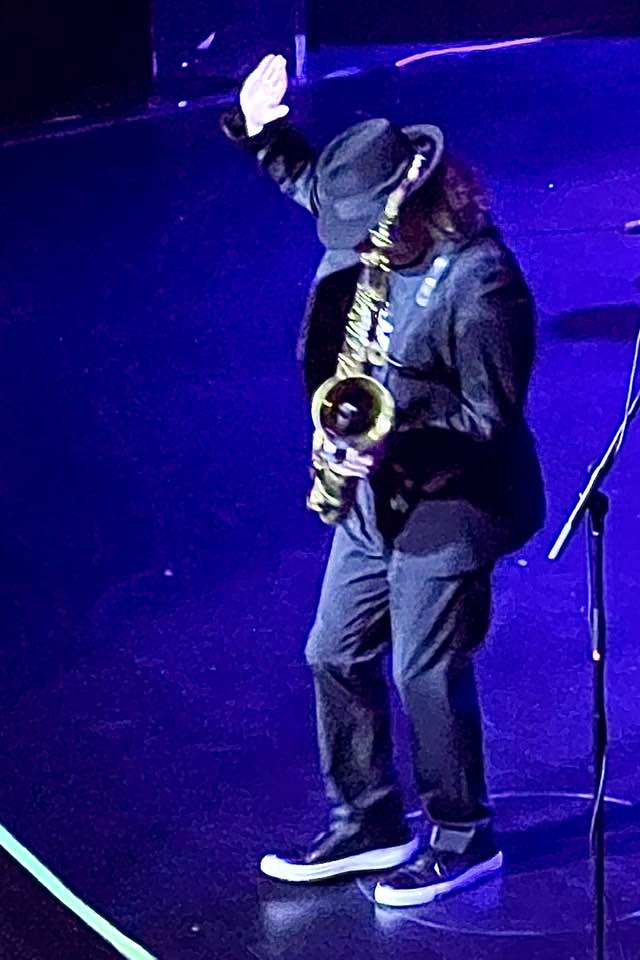
Boney James was outfitted in his signature apparel--a black Fedora hat, dark jeans, spiffy sneakers, and a crew neck shirt with a suit jacket. He was accompanied by Big Mike Hart on guitar, keyboardist Jonathan Richmond, drummer Omari Williams, and bass guitarist Smitty Smith. You could see and feel the chemistry between the group. In the audience, heads swayed side-to-side while bodies gyrated to the explosive rhythms. The drummer blew the roof off the building with a booming and powerful solo. Big Mike soon followed with an electrifying lick on his guitar. Boney James was phenomenal as he gracefully moved across the stage connecting with his enthralled audience.

Photos and video by Anne-Merle Bryant

37 John Street, Charleston, SC, 843-853-2252

Box Office Hours: Thursday and Friday 10 am-3 pm

Charleston Music Hall Schedule

Monday, December 30, 2013

Blue Dogs 25th Anniversary Show At The Charleston Music Hall Was A Doggone Good Show

The lively and diverse Upper King Street around the John Street area is a mecca of shops, restaurants, and bars. Last night, the outdoor temperature was perfect for taking a window gazing stroll or for doing some people watching at the outdoor venues of the local establishments, such as 39 Rue de Jean, Hall's Chophouse, Republic, and Joe Pastas, which were all standing room only. Everyone was having a howling good time pre-concert and then around 8:00 pm, the whole affair took the expected turn.

The Charleston Music Hall proceeded to go to the dogs - more appropriately, the Blue Dogs. It was a celebration of their 25th Anniversary Show and from the front doors to the backstage - where the real party was obviously taking place - it was a rockin' good time. They picked and sang to a sold out Hall with a 3 1/2 hour, non-stop parade of special guests including Radney Foster, Edwin McCain, Don Lotti, Danielle Howle, John Satterfield and the Archtypes to name a few, but that was just the 'Dog' treats.

Bobby Houck, acoustic guitarist and vocalist for the Blue Dogs, tossed out a 'Dog' biscuit when he lightheartedly proclaimed his long-time partner, standup bassist Hank Futch, had been cheating on him by his Occasional Milkshake collaboration with high-spirited guitarist Mark Bryan of Hootie and the Blowfish, who joined the group on stage. Hank and Mark along with Doug Jones and Gary Greene performed a couple of their songs and Mark did a duet with Danielle Howle of Firework Show.

To top off the highlights, the big 'Dog' bone came late in the second set when Bobby invited Charleston's favorite son, Darius Rucker, out from the backstage to sing the Blue Dogs hit song "Isabelle" and it was a free-for-all from there. Darius and the Blue Dogs next sang the Bob Dylan-Old Crow Medicine Show inspired song that has become the now famous Rucker version of "Wagon Wheel" from his "Lady Antebellum" album and the roof blew off the house.


Hootie and the Blowfish joined the pack and performed a couple of their hits including the song "Time". Radney Foster rejoined the group with a couple more songs. Daren Shumaker dazzled on the mandolin and David Stewart artfully played the guitar. The night was closed out with the whole gang of performers joining the Blue Dogs in a climaxing tribute to their Mama's with their "Make Your Mama Proud" song from their 2004 album "Halos and Good Buys". In the finale, there were so many musicians on stage Radney Foster couldn't find an available plug-in for his guitar. So, he did what all good musicians do - he improvised.

Everyone present, including yours truly,  had a doggone good time, but the continuous parade of honky-tonkers and bluegrass musicians gave fits to the stage hands that handled the assortment of guitars and mandolins with their array of plug-ins and foot pedals. Despite a couple of glitches, they handled the challenge superbly accompanied by a well orchestrated light show. It was well worth the $21.05.

The Charleston Music Hall, one of the oldest buildings on the block, was constructed in the mid-nineteenth century by the South Carolina Railroad, known historically as The Tower Depot. It was designed to resemble a Medieval castle and featured a three-story tower that was unfortunately destroyed in the Charleston Earthquake of 1886. The rest of the building sat vacant for sixty years, until 1995 when it was transformed into the intimate, first class performance space it is today.

"There is not a bad seat in the house," is an appropriate slogan. I can attest to that fact. My seat was in section H-REAR, Row 9, Seat 9, the bird's-eye view on the second level. I could still see the facial expressions of the performers.


Click on Charleston Music Hall for upcoming shows and performances. February 13th will be the Elise Testone Album Release Show. You can purchase tickets here.