
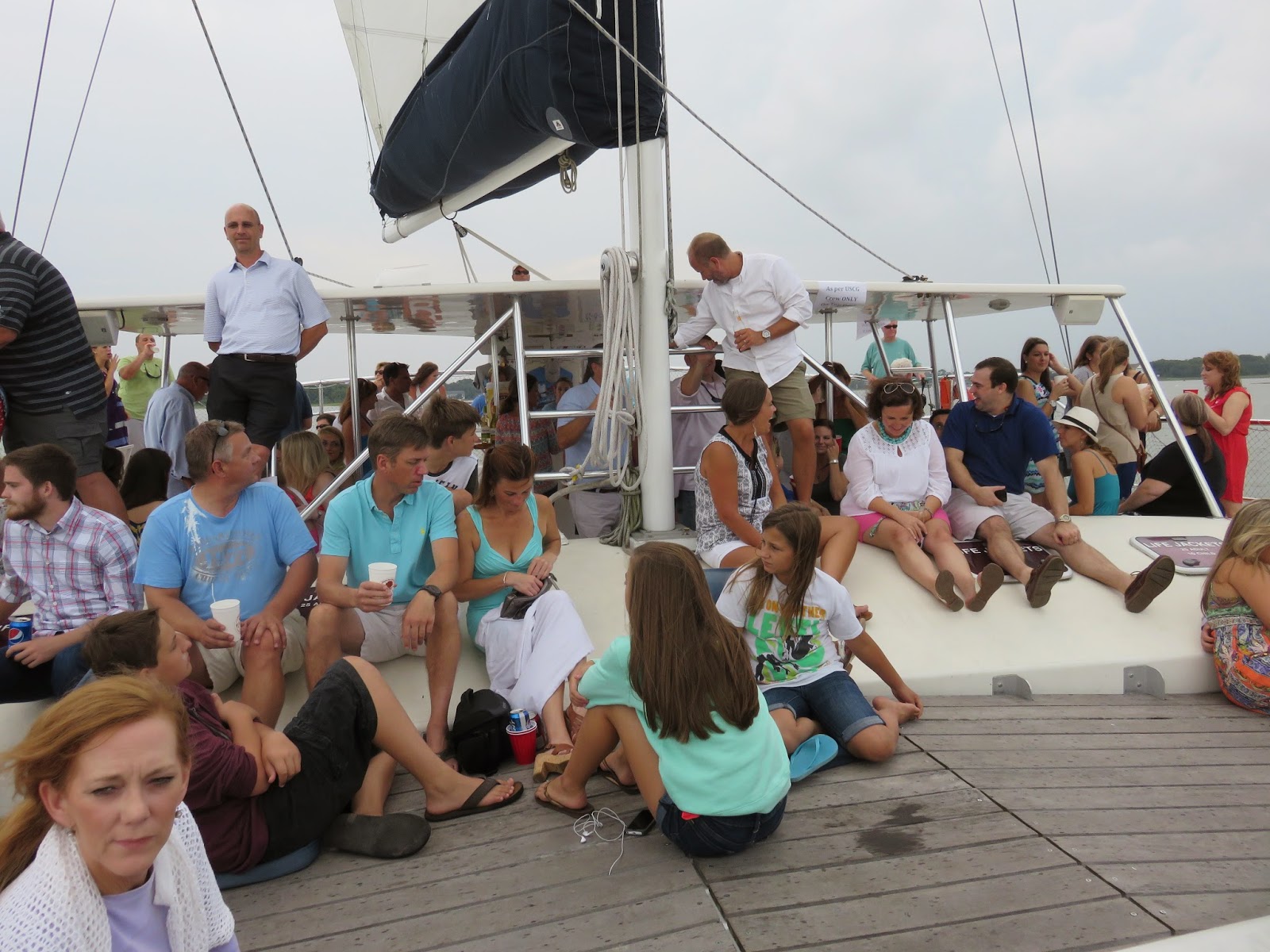
Thunderstorms were scattered about the Charleston area but the Harbor around Mt. Pleasant's popular waterside mecca of watering holes at Shem Creek was luckily spared and basking in a moisture-rich late afternoon sun. Departure time had arrived.
With a full compliment of passengers, the catamaran's crew loosened the moorings and it eased away from the dock into the gentle out-going current. The age-diverse crowd of passengers gave out cheers of approval. We waved to the patrons lining the weatherworn rails along the waters edge of Tavern and Table and Red's Ice House as they gave us a Titanic send off. The party was now officially underway.
While navigating the narrow waters around recreational crafts of all sizes, the captain introduced himself and shouted out some pertinent instructions. It was Firefly Friday. Complimentary glasses of a Firefly Vodka laced drink were passed out. We crossed glasses and caught a glimpse of a shrimper dancing to some island music as our vessel passed-by. The bird sanctuary called Crab Bank Island came into view and the open waters of Charleston Harbor spread before us like a sparkling glass of wine. The sails were unfurled and the stimulating harbor breeze softly embraced our host, the Palmetto Breeze.
The Palmetto Breeze was built in Charleston and is the largest capacity catamaran north of Ft. Lauderdale accommodating 100 passengers plus crew. It featured a spacious wooden deck and covered seating by the bar with elevated seating across the back. In the front of the catamaran under the jib sail, three rows of eight leg-less chairs each were set up across the deck. If you were among the first to board, you had the ideal option of choosing one of these chairs. They were actually very comfortable and afforded a great view.
There was by far more passengers than there was seating. Most of the passengers, which consisted of families, couples, and one bachelorette party, sat wherever it was convenient or stood along the roped edges.
With the Ravenel Bridge towering over Patriots Point and the Yorktown in the near distance, the Breeze crossed the harbor waters passed Castle Pinckney toward White Point Gardens and sailed along the waterfront from the Battery to the South Carolina Aquarium.
The earlier storms had moved out of the area and through breaks in the slow moving marine blue clouds, the descending sun afforded some beautiful shots. Passing the port docks, next was the Ravenel Bridge where the Breeze briefly lingered under the soaring cabled-spires and then made the turn towards the Yorktown and Patriots Point. By then, the near-full moon had made its appearance, adding to the splendor of the darkening azure skies.
Finally, after four glasses of Firefly and one glass of wine, it was time to head back to port. The sun had disappeared below the clouds and the fading Charleston horizon. There was no mistaking Shem Creek. It was colorfully lit like a theater marquee--resplendent.
The harbor tour aboard the Palmetto Breeze is well worth the ticket. It was comfortable, it was relaxing, and it was enjoyably fun. There is no narrative. History is not on the agenda. It is all about soaking in the romance of the Charleston Harbor ambiance--salt water, ocean breezes, and the unrivaled, beautiful waterfront of Charleston. Firefly Vodka was complimentary. Water and soft drinks were provided along with a cash bar as refreshments.
The Firefly Friday cruise is no longer available. It has been replaced with the Pure Gold Friday Sunset cruise which includes wine and beer products. The following list is available cruises, times, and prices.
Like the ocean tides, history has flowed in and out of Charleston Harbor since its inception. An inlet formed by the confluence of the Ashley and Cooper Rivers and a maze of wild-life-rich barrier islands, it was the perfect location to start a colony and establish what has become the charming and hospitable city of Charleston. From Oyster Point on the peninsula to Fort Sumter at the entrance and back, its coastline offers roughly 10 miles of scenic beauty and rich history. Yet, those same ocean tides reinforced by the power of the natural and unnatural order of things have now and again whipped up its shifting sands of time and rearranged the harbor's protective estuary islands, three in particular.
The phrase "shifting sands of time" is an old saying usually associated with an hour glass. Its meaning forebodes a change in circumstances. A famous lighthouse outside of Charleston Harbor, once a proud guardian of the coastline, now a vanquished sentinel, was victimized by the shifting sands of time, literally. The lighthouse residents and visitors see today was constructed beginning in 1873 and completed 1876. It was named the Morris Island Lighthouse because that is where it once upon a time stood. Sounds like the beginning of a fairy tale, but this is no fairy tale.
The Morris Island Lighthouse no longer stands on Morris Island. The sands upon which it was built have been altered and this is where our story has a twist. Once upon a time Morris Island was actually three islands that stretched from Folly Beach to Sullivan's Island, and the lighthouse you see today was not the first Charleston lighthouse. The three islands were named Middle Bay Island, Morrison Island, and Cummings Point.
The first Charleston lighthouse was built on the 565 acre Middle Bay Island in 1767. The tower rose forty-three feet and served well, until it was darkened for a period during the Revolutionary War. After the war, the federal government took control of the island and various improvements were subsequently made to increase the range of the light. During 1801 and 1802, the tower was heightened, and in 1812 an Aragand lamp-reflector system was installed.
In time, changing tidal currents altered the channel leading into Charleston and the three islands slowly merged into one and became just Morrison Island, later shortened to Morris. In the 1830s, the Lighthouse Service built a new, 102-foot tower to replace the 1767 tower. In 1854, a hurricane struck the lighthouse. The keeper's dwelling was destroyed and the tower was damaged. When the lighthouse was repaired, a revolving new first-order lens light with a range of 12 miles was installed in the tower on January 1, 1858. The tower had survived the battle with the hurricane, but the Civil War came and the lighthouse suffered an explosive ending. Fleeing Confederate troops blew up the lighthouse so Union troops couldn't benefit from it.
The lighthouse we see today was the replacement for the destroyed lighthouse. Completed in 1876, the lighthouse was built 400 yards away from the original one standing 161-feet tall with a pattern based off the Bodie Light off the Outer Banks in North Carolina. A first-order Fresnel lens was installed. In 1884 the illuminating apparatus was changed for the use of mineral oil instead of lard oil. Morris Island now contained 15 buildings, including the keeper's quarters, various outbuildings, and a one-room schoolhouse.
This is where the story takes a twist. The channel shifted once again. This time threatening Charleston Harbor, which could not be allowed to happen. Jetties were built--saving the harbor, but the result caused severe erosion on Morris Island. The island shrunk. Many of the buildings, which included the keeper's house and a school house, were destroyed by other powerful natural forces or moved.
The 1886 earthquake cracked the tower extensively in two places, but not so as to endanger its stability. The cracks were repaired. In 1989, Hurricane Hugo struck Charleston, destroying the remaining buildings around the lighthouse, only leaving the actual tower standing. Slowly, the shifting sands retreated from around the lighthouse. The light was automated in 1938 and the Fresnel lens was removed. It continued to operate until it was eventually decommissioned in 1962.
The lens installed at Morris Island was a first-order Fresnel lens--the largest, most powerful and expensive lens with an illuminating apparatus fueled by mineral oil. A Fresnel lens is a multi-part lens developed by French physicist and engineer Augustin-Jean Fresnel. When compared to a conventional lens it is much thinner, larger, and flatter, and captures more oblique light from a light source, thus allowing lighthouses to be visible over much greater distances.
The lighthouse address is now several hundred feet in the ocean. Yes, literally surrounded by the deep blue sea. The Coast Guard planned on destroying it, but local residents came to the rescue. It is now privately owned and efforts have been ongoing to preserve it.
The Morris Island Lighthouse is just one of many in a system of lighthouses built up and down the East Coast--standing as protectors and guides. Some of them are still active, some of them are not. Some of them are open to the public, some are not. They are great subjects for photographs and their history is fascinating. To see what life was like for the caretakers and keepers of the lighthouses, visit one and take on the experience of climbing the hundreds of stairs to the top. The view is spectacular.
The Morris Island Lighthouse, for obvious reasons, is not open to the public. You can view it from the shores of Folly Beach or up close and personal on the Morris Island Lighthouse Eco Tour. Another historical site on the island affected by the erosion was Fort Wagner--the famous Confederate fort featured in the movie "Glory." Although the jetties caused the erosion of Morris Island, it saved Charleston Harbor.
Interested in other lighthouses nearby:
To the north of Morris island Lighthouse and beyond Bull's Island, in the Cape Romain National Wildlife Refuge, resides Lighthouse Island where you can tour two lighthouses--one conical in shape rising to a height of 65 feet and the other octagonal standing 150 feet from sand to top. The 1827 lighthouse is the oldest of its kind still standing in the United States. They are a part of the Cape Romain Lighthouses Tour only scheduled four times a year.
Another lies just south, on Hunting Island. The 132 foot, 167 step Hunting Island historic lighthouse is the only lighthouse open to the public to climb in the state. From the top platform, you can get a breathtaking view of the ocean, beach and the marshland.
Thunderstorms were scattered about the Charleston area but the Harbor around Mt. Pleasant's popular waterside mecca of watering holes at Shem Creek was luckily spared and was basking in a moisture-rich late afternoon sun. Departure time had arrived.
With a full compliment of passengers, the catamaran's crew loosened the moorings and it eased away from the dock into the gentle out-going current. The age-diverse crowd of passengers gave out cheers of approval. We waved to the patrons lining the weatherworn rails along the waters edge of Red's Ice House as they gave us a Titanic send off. The party was now officially underway.
While navigating the narrow waters around recreational crafts of all sizes, the captain introduced himself and shouted out some pertinent instructions. It was Firefly Friday. Complimentary glasses of a Firefly Vodka laced drink were passed out. We crossed glasses and caught a glimpse of a shrimper dancing to some island music as our vessel passed-by. The bird sanctuary called Crab Bank Island came into view and the open waters of Charleston Harbor spread before us like a sparkling glass of Firefly Vodka. The sails were unfurled and the stimulating harbor breeze softly embraced our host, the Palmetto Breeze.
The Palmetto Breeze was built in Charleston and is the largest capacity catamaran north of Ft. Lauderdale accommodating 100 passengers plus crew. It featured a spacious wooden deck and covered seating by the bar with elevated seating across the back. In the front of the catamaran under the jib sail, three rows of eight leg-less chairs each were set up across the deck. If you were among the first to board, you had the ideal option of choosing one of these chairs. They were actually very comfortable and afforded a great view.
There was by far more passengers than there was seating. Most of the passengers, which consisted of families, couples, and one bachelorette party, sat wherever it was convenient or stood along the roped edges.
With the Ravenel Bridge towering over Patriots Point and the Yorktown in the near distance, the Breeze crossed the harbor waters passed Castle Pinckney toward White Point Gardens and sailed along the waterfront from the Battery to the South Carolina Aquarium.
The earlier storms had moved out of the area and through breaks in the slow moving marine blue clouds, the descending sun afforded some beautiful shots. Passing the port docks, next was the Ravenel Bridge where the Breeze briefly lingered under the soaring cabled-spires and then made the turn towards the Yorktown and Patriots Point. By then, the near-full moon had made its appearance, adding to the splendor of the darkening azure skies.
Finally, after four glasses of Firefly and one glass of wine, it was time to head back to port. The sun had disappeared below the clouds and the fading Charleston horizon. There was no mistaking Shem Creek. It was colorfully lit like a theater marquee--resplendent.
The harbor tour aboard the Palmetto Breeze is well worth the $35 ticket. It was comfortable, it was relaxing, and it was enjoyably fun. There is no narrative. History is not on the agenda. It is all about soaking in the romance of the Charleston Harbor ambiance--salt water, ocean breezes, and the unrivaled, beautiful waterfront of Charleston. Firefly Vodka was complimentary. Water and soft drinks were provided along with a cash bar as refreshments.
Like the ocean tides, history has flowed in and out of Charleston Harbor since its inception. An inlet formed by the confluence of the Ashley and Cooper Rivers, it was the perfect location to start a colony and establish what has become the charming and hospitable city of Charleston. From Oyster Point on the peninsula to Fort Sumter at the entrance and back, its coastline offers roughly 10 miles of scenic beauty and rich history.
Boasting the deepest water in the southeast region, huge ocean going container vessels enter the harbor on a daily basis--one of the busiest ports on the east coast. You will also on occasion see the cruise ship Carnival Fantasy arriving and departing year-round bound for the Bahamas and back. Tour boats from Charleston Harbor Tours and Spirit Line Cruises criss-cross the waters every day carrying locals and visitors on narrative tours around the harbor past 75 different landmarks and points of interests. Two of the points of interest connected to Charleston Harbor are my favorite places to hang out--Patriots Point and Shem Creek.
On the edge of the harbor, Patriots Point is the place for spectacular views. The Charleston Harbor Resort hosts a beach party every Friday from April to July. You can kick off whatever foot wear you are wearing and sink your toes into its soft, cool sand while listening to the tunes of local bands--one of the top ten on my list of things to do. Connected to the beach, a long walking pier provides you with a great view of the whole harbor while its balmy breezes wash over you with a splash of salt water scent. Nearby, the Fish House Restaurant overlooks the marina where the Yorktown is permanently moored and the Ravenel Bridge towers over the Cooper River. Spiritline Cruises dock on the Point as well.
Shem Creek is a restaurant/bar mecca with a gallimaufry of warm weather activity. Historically a safe haven for a fleet of shrimp trawlers to unload their catch and mend their nets, it is also a docking and launch point for pleasure craft of all sizes from cabin cruisers to kayaks. The waterfront bars at Water's Edge, Red's Ice House, Vickery's and RB's are popular gathering places for watersport enthusiasts to meet and greet. Also great for picture taking and for viewing the Charleston sunset. For me, the lazy waters of the creek is the perfect place to dangle my feet and launch a paddleboard. With dolphin frequenting these waters along with an occasional manatee, you just may have a once in lifetime experience similar to mine.
I had just paddled past RB's and was in the area near Vickery's. Straight ahead from my position, I saw two dolphins seemingly moving in my direction. At a point of twenty feet from me, they submerged. I ceased paddling with hopes they would continue on their course. I waited and watched, watched and waited. Looking toward the water on the right side of my paddleboard, I saw the outline of the grey mammals just below the water's surface swimming to the edge of my board. The board rocked gently from the shifting waters. It was that precise moment I experienced an epiphany. We stared into each other's eyes, locked in a mutual gaze. Even though the exchange was brief and words were not spoken, I felt a connection was made in that rarest of moments--unfortunately, to quick for a picture. It was surreal. That's my story and I'm sticking to it.
Shem Creek is also where the Palmetto Breeze docks. Built in Charleston, it is the largest capacity sailing catamaran north of Ft. Lauderdale with room for more than 100 crew and passengers. It features a spacious wooden deck with covered seating by the "barefoot" bar. You will find two bathrooms below, and speakers throughout. Dolphin Sails, Pirate Adventures, Historic Charleston Harbor Cruises, Sunset Sails are on its itinerary. All charters, public and private, include complimentary bottled water and soft drinks. Cash bar is open for scheduled public sails and some include free adult beverage.
Here are some ways to enjoy the beauty of historical Charleston Harbor:
Charleston Harbor Tours Presents a Murder Mystery Cruise
07/09/2014
City Marina
17 Lockwood Dr, Charleston, SC 29401
843.722.1112 http://www.charlestonharbortours.com/
Craft Brews Cruise
07/04/2014
The Carolina Queen at the City Marina
17 Lockwood Dr.
Charleston, SC 29403
843.722.1112 http://www.charlestonharbortours.com/
PALMETTO BREEZE Margarita Monday!
July 7, 2014 7:00 PM
100 Church Street
Mt. Pleasant, SC
General admission $35.00 Ladies $25.00
PALMETTO BREEZE "2 for Tuesday" Sunset Sail
July 8, 7:00 PM
100 Church Street
Mt. Pleasant, SC
General admission $35.00
The scenic view of Charleston Harbor is alluring to amateur photographers and armchair historians alike because it is beautifully picturesque and enchantingly historical. As you survey the coastal layout of Charleston Bay, you will find there are many idyllic vantage points from which to soak in the ambiance of Charleston's long lived harbor. Each point of reference offering a different line of sight both visually and factually. Anywhere along the promenade walkway on E. Battery ending at White Point Gardens would be one such location, Waterfront Park another, and the South Carolina Aquarium yet another.
White Point Gardens was once occupied at different times by two forts, first Fort Broughton in 1735 and then Fort Wilkins in 1812. At that time this area at the point of the peninsula was called White or Oyster Point because of the piles of bleached oyster shells, which Charleston waters have an abundance of, oysters that is. In time it became a park and a placement for artillery during the Civil War. Today, the park is occupied by a gazebo, some memorials, cannons and mortars used in the Civil War, and all under a canopy of large southern live oaks. Across the street are some of Charleston's most beautiful mansions, including the Battery Carriage House Inn and Two Meeting Street Inn. But now, we come to the reason for its mention in this article. It boasts unprecedented views of Charleston Harbor. In the distance you can see Fort Sumter, Castle Pinckney, the World War II aircraft carrier USS Yorktown, Fort Moultrie, and Sullivan's Island. Bet you can't resist having your picture taken standing by one of the cannons.
Southern live oaks at White Point Gardens
Mortar and shells
View of Charleston Harbor from White Point Gardens
Charleston mansion across from White Point Gardens
Waterfront Park was deemed “this generation’s gift to the future” by Mayor Riley. The park is an eight-acre linear park. It masterfully combines spectacular fountains, spacious lawns for kids to play on, walking and jogging paths. You can sit on one of several family-sized swings on the pavilion and watch ships come and go. You will enjoy the swings. The two artfully designed enormous fountains are a tempting invitation to children to splash and play, including adventurous adults who are so inclined to indulge. The famous Charleston Pineapple Fountain is a focal point of the park. More specifically, it highlights a pier spanning over 1,000 feet along Charleston Harbor. Relax, take pictures, imagine the history. You can see the Arthur Ravenel Bridge to the left, panning right Patriot's Point comes into view with the U.S.S. Yorktown, and beyond, Fort Sumter. It is Located in the Vendue Range on Concord Street.
Waterfront Park pier
Arthur Ravenel Bridge viewed from Waterfront Park pier
The South Carolina Aquarium needs no introductions. It is the number one attraction in Charleston. The mission of the South Carolina Aquarium is to inspire conservation of the natural world by exhibiting and caring for animals, by excelling in education and research, and by providing an exceptional visitor experience. You can view shoreline favorites such as herons, diamondback terrapins, and puffer fish as well as the all-new stingray exhibit with more than 25 stingrays in the Saltmarsh Aviary. Catch a glimpse of a rare albino American alligator in the Albino Alligator Experience. It is home to four ring-tailed lemurs in the new Madagascar Journey exhibit. The aquarium has a massive, two-story Great Ocean Tank which holds 385,000 gallons of salt water and contains hundreds of fish, invertebrates, sea turtles and marine mammals. The 4-D Theater combines 3-D imagery, interactive seating and waves of special effects such as gusts of wind, splashes of water and movement under your feet. This is only a sampling. Noteworthy is the Great Hall, which features two-story windows offering one of the best views in town of Charleston Harbor.
These are all great places to visit for exceptional views of the harbor, but none is better than the pier at Charleston Harbor Resort and Marina located right on the banks of the harbor on Patriot's Point. The Charleston Harbor Resort and Marina offers a full service marina, complete with fishing charters, sailing excursions and lessons. For the golpher, there is a challenging 18-hole championship golf course located adjacent to the hotel called Patriot Point's Links. As a complimentary service, the resort Trolley or the Charleston Water Taxi (seasonal) will give you a quick ride to historic Charleston for a day of shopping, dining and sight seeing, eliminating the frustration of finding a parking spot for your car. As to the view of the harbor, the resort has a walking pier that extends far out into the bay. From the end of the pier you can see everything in the harbor, including Charleston. The huge container-carrying ships coming and going throughout the day cruise so close you feel as though you could reach out and touch them.
Charleston Harbor Resort and Marina pier
The U.S.S. Yorktown viewed from the pier
Charleston Harbor Resort viewed from the pier
The Charleston Harbor Resort is also the host of the Party at the Point scheduled every Friday from April to the end of June. It starts at 5:30pm and ends at 9:30pm. Live music performed by some of the areas best local and regional bands usually begins around 6:30pm. The event is billed as Charleston's premiere happy hour concert with drink specials and $2 draft beer. It is right on the beach where you can relax with friends or dance to the music in your bare feet. I always have a great time, you will too. Ticket prices range from $5-$7. Parking is free except valet parking is $5. So, do you get the point, get to the point.
Party at the Point schedule:
June 8: Simplified w/Of Good Nature
June 15: Beatles Night w/Sgt. Submarine
June 22: Sol Driven Train w/Fowler’s Mustache
June 29: Drivin N Cryin w/ Luke Cunningham
The phrase "shifting sands of time" is an old saying usually associated with an hour glass. Its meaning forebodes a change in circumstances. A famous lighthouse outside of Charleston Harbor, once a proud guardian of the coastline, now a vanquished sentinel, was victimized by the shifting sands of time, literally. The lighthouse residents and visitors see today was constructed beginning in 1873 and completed 1876. It was named the Morris Island Lighthouse because that is where it once upon a time stood. Sounds like the beginning of a fairy tale, but this is no fairy tale.
The Morris Island Lighthouse no longer stands on Morris Island. The sands upon which it was built are no longer there and this is where our story has a twist. Once upon a time Morris Island was actually three islands that stretched from Folly Beach to Sullivan's Island, and the lighthouse you see today was not the first Charleston lighthouse. The three islands were named Middle Bay Island, Morrison Island, and Cummings Point.
The first lighthouse tower built in 1767 stood 102 feet and had a revolving lamp with a range of 12 miles. In time, changing tidal currents altered the channel leading into Charleston and the three islands slowly merged into one and became just Morrison Island, later shortened to Morris. Then, the Civil War came and the lighthouse suffered an explosive ending. Fleeing Confederate troops blew up the lighthouse so Union troops couldn't benefit from it.
The lighthouse we see today was the replacement for the destroyed lighthouse. It stands at a height of 161 feet. This is where the story takes a twist. The channel shifted once again. This time threatening the Charleston Harbor, which could not be allowed to happen. Jetties were built, saving the harbor, but the result caused severe erosion on Morris Island. The island shrunk. Many of the buildings, which included the keeper's house and a school house, were destroyed by other powerful natural forces or moved. Slowly, the shifting sands retreated from around the lighthouse. The light was automated in 1938 and the Fresnel lens was removed. It continued to operate until it was eventually decommissioned in 1962.
The lighthouse address is now several hundred feet in the ocean. Yes, literally surrounded by the deep blue sea. The Coast Guard planned on destroying it, but local residents came to the rescue. It is now privately owned and efforts are underway to preserve it.
The Morris Island Lighthouse is just one of many in a system of lighthouses built up and down the East Coast--standing as protectors and guides. Some of them are still active, some of them are not. Some of them are open to the public, some are not. They are great subjects for photographs and their history is fascinating. To see what life was like for the caretakers and keepers of the lighthouses, visit one and take on the experience of climbing the hundreds of stairs to the top. The view is spectacular.
The Morris Island Lighthouse, for obvious reasons, is not open to the public. You can view it from the shores of Folly Beach. Another historical site affected by the erosion was Fort Wagner--the famous Confederate fort featured in the movie "Glory" with Matthew Broderick as Colonel Robert Gould Shaw. Although the jetties caused the erosion of Morris Island, it saved Charleston Harbor. It is a great place to fish.
The lens installed at Morris Island was a first-order Fresnel lens--the largest, most powerful and expensive lens with an illuminating apparatus fueled by mineral oil. A Fresnel lens is a multi-part lens developed by French physicist and engineer Augustin-Jean Fresnel. When compared to a conventional lens it is much thinner, larger, and flatter, and captures more oblique light from a light source, thus allowing lighthouses to be visible over much greater distances.
I recently went on a trip to Corolla, Outer Banks and toured the Currituck Lighthouse, which heightened my interest to check out Charleston's lighthouses.