Showing posts with label Charleston plantations. Show all posts

Sunday, February 8, 2026

A Lowcountry Legend from Runnymede Plantation—and the History that Shaped it

Runnymede Plantation 1917
In the Lowcountry, history is never just something you read in books. It breathes. It clings to the air like humidity, settles into the marsh grass, and whispers beneath the live oaks. Some stories rise from that landscape with such insistence that they become part of the region’s cultural marrow. The tale of what happened at Runnymede Plantation one September afternoon is one of them.

The year has slipped from memory, but the season has not. It was late summer, the kind of day when the Ashley River glints like hammered pewter and the cicada's drone with a last burst of bravado. Two brothers from Charleston—teenagers on the verge of leaving for school in another state—had come to Runnymede for a final outing before their departure. The plantation had long been a place of adventure for them, a patchwork of riverbank, marsh, and forest where boys could roam freely and imagine themselves explorers.

Runnymede Plantation today

Runnymede’s landscape, like much of the Lowcountry, is a living archive of natural and human history. Alligators patrol the rice‑field canals. Egrets lift from the reeds in sudden white flashes. And tucked deep within the woods are remnants of a past that is neither forgotten nor fully at rest. It was there, in the quiet shade of the forest, that the brothers stumbled upon an old slave burial ground.

To the untrained eye, the graves might have seemed simple—mounds of earth, weathered by time. But atop each one lay a careful arrangement of personal belongings: plates, cups, tools, a favorite chair, a bottle of medicine with a spoon resting beside it. These were not random objects. They were part of a tradition carried to the Lowcountry by Africans, rooted in West African cosmology. The practice—placing the deceased’s possessions atop the grave—reflected a belief that the boundary between the living and the dead was permeable. Objects used in life could accompany the spirit into the next world. To disturb them was to disturb the dead themselves.

By the nineteenth century, this tradition had become deeply woven into Gullah‑Geechee culture. Even those who did not personally believe in the spiritual consequences respected the custom. It was an act of reverence, a recognition of humanity in a world that had denied it. The brothers knew the stories. Everyone in the Lowcountry did. But youth have a way of mistaking knowledge for immunity.

Seeing the objects laid out on the graves, the boys decided to play what they considered a harmless prank. They lifted a drinking glass from one of the mounds—laughing, perhaps, at the idea of “superstition”—and carried it home to Charleston as a souvenir. Their parents did not share their amusement.

They weren’t believers in curses, but they understood the weight of what had been done. The issue was not fear of spirits. It was respect—respect for the people buried at Runnymede, for the descendants who still lived nearby, and for the cultural traditions that had survived enslavement, war, and time itself. The parents contacted the plantation owners immediately. The glass was returned to the burial ground and placed exactly where it had been. But word had already spread among the community at Runnymede. And the consensus was quiet, solemn, and unwavering. It was too late.

The next morning, the brothers boarded the jet for school. They never arrived. The details of the tragedy have blurred with retelling—some say an accident, others a sudden illness—but the outcome was the same. When news reached Runnymede, no one expressed shock. No one questioned how such misfortune could have happened. Among those who held fast to the old beliefs, the explanation was simple. The spirits had been disturbed.

Whether one believes in supernatural retribution or not, the tale endures because it speaks to something deeper than folklore. It is a reminder of the cultural traditions carried by Africans—traditions that survived against all odds and still shape the Lowcountry’s identity. It is also a story about reverence: for the past, and for the communities whose histories are too often overlooked.

Runnymede Plantation, like so many places in the South, holds layers of memory. Some are beautiful. Some are painful. All deserve respect. And sometimes, the land itself seems to insist on it.


Note: This story is a mix of some fiction and historical facts. However, it is associated with an actual event.

Runnymede Plantation is not open to the public. It is used for special events and weddings.

Friday, March 8, 2024

Drayton Hall House Tour--See One of the Lowcountry's Greatest Architectural Treasures

Founded in 1738, Drayton Hall is a preeminent example of Georgian-Palladian architecture in the United States. It is one of the most significant, undisturbed historic landscapes open for public viewing. Its amazing and timeless wood and plaster carvings are a testimony to the artful skills of the master craftsmen of the day. The stories told offer a brief glimpse into the people who lived and served within its majestic walls. All of which have been preserved in their original true to life state of being, unvarnished both physically and spiritually.

Upon arrival, you will want to check in, and you do this at the gift shop. While you wait for the house tour to start, and you are encouraged to do this, you can take a self guided stroll around the visitor center. A brief orientation film is offered in the Stephen F. and Laura D. Gates Gallery along with a full-wall time line. The adjacent room, in the same building, includes rotating exhibitions of decorative arts objects that once belonged to the Drayton family, examples of authentic house furniture, archaeological artifacts related to the estate and its inhabitants, as well as archival materials and architectural fragments.

Anchoring the visitor center, the Lenhardt Garden surrounds a sprawling 200-year-old oak tree. The plantings are historically inspired, with horticultural specimens related to John Drayton's botanical lists. There is a grouping of benches upon which you can sit and soak in the tranquil surroundings and enjoy the seasonal flora and fauna.

The exhibit in the caretaker's house highlights the post-Civil War period and the 20th century at Drayton Hall. Constructed in 1870, the caretaker's house was built for the caretaker to watch over the main house and grounds while phosphate was mined on the property. The house has been rehabilitated to serve as a conditioned exhibit space, creating opportunities to see layers of its construction and decorative materials. Of course, you can enjoy these three amenities any time before or after your tour.

Once the tour begins, the guide introduced us to the complex where it begins. Then explains the radical decision that was made to preserve the seven generations of history within Drayton Hall's walls. The choice was made to stabilize the house rather than restore it to a particular period, and to preserve it as it was acquired from the family in the 1970s. All imperfections and changes over time have survived to the present.

Next, we were led to an archeological dig next to the main house. It reveals what was originally one of the flanker buildings that once upon a time stood on each side of the main house and connected by a tall brick colonnade. It is an essential element of a one time unknown surprising twist in the house's history.

Drayton Hall is unquestionably not without its mysteries, both surreal and real. The most recent and famous occurred in 2007 when one of its staff members received an anonymous package containing the photograph of a watercolor painting of Drayton Hall purported to be date back to 1765. The envelope it arrived in was simply postmarked 22602-6754 with the words ATT: Back in The Day. The numbers were found to be a Winchester, VA zip code.

Up to that moment, no 18th-century image of Drayton Hall had ever been found. The earliest dated to c. 1845. The mystery was deepened further by what they saw depicted in the watercolor. It presented an image of Drayton Hall never seen before. It showed the Palladian brick building surrounded by low colonnades. Inspired by this revelation, archaeologists dug into the museum's lawn, where 18th-century foundation marks were found, suggesting the 1765 drawing of a u-shaped colonnade was an accurate portrayal.

The tour moved to the main house beginning in the cellar, which housed mainly the kitchen. From there, we exited to the grand portico, the first floor, and finally the second floor. After entertaining and thought provoking stories on each floor about the people who lived and worked in the house, we were turned loose to go wherever we wanted at our own leisure. Before exiting the property, we took the solemn stroll through the African American Cemetery.


If you are looking for the complete southern experience, Drayton Hall should be on your list. From the moment you enter the gate and drive up the narrow causeway toward the columned portico's of the house's stunning front entrance, you sense a change in time. And, when you ascend the stone stairs facing the Ashley River and step through the door, the sudden rush of humid antebellum air swoops you back to an era of ballroom serenades, afternoon tea, and plantation living both elegant and controversial.

Voted the Best Place to See by Condé Nast Traveler.

Tickets for the House Tour

Tickets for Private Guided Tours

Plantation Tour Combination Tickets

Group Tours

Tuesday, January 17, 2023

Candlelight Tours of Drayton Hall In Charleston--Affords You the Opportunity to See the Estate in a Different Light

Everything looks different in the fading light of the setting sun. The colors of the day melt away as they give way to the intruding darkness washing over the surrounding landscape like a rogue wave. Once upon a time sleeping shadows come to life, energized by any light source nearby. In the changed aura, one's imagination becomes more sensitive. Drayton Hall's Candlelight Tour does exactly all that. It allows you to see the old Ashley River estate and its impressive house in a different shade of light.

Originally a fruit orchard, Drayton Hall was built somewhere around 1738, thus making it over 285 years old. Considered one of the earliest and finest examples of Georgian-Palladian architecture in the United States, it is part of the most significant, undisturbed historic landscapes in North America.

Inside, the timeless wood and plaster carvings give testimony to the artful skills of the master craftsman of the day and the soul of its owners. The house is a surviving relic for us to look at with curiosity and wonderment. For the people in its beginning, every nuance incorporated into its design had a special meaning.

Drayton Hall is unquestionably not without its mysteries, both surreal and real. The most recent and famous occurred in 2007 when one of its staff members received an anonymous package containing the photograph of a watercolor painting of Drayton Hall purported to be date back to 1765.

The tour began at the Visitor Center, where Rosemary, our guide, talked about the Drayton Hall Preservation Trust's mission, which is to foster a deeper understanding of colonial America and the evolution of life in the South by discovering, researching, conserving, and interpreting the history, context, and culture of Drayton Hall.


Next, we were led to a graveled circle under some of the estate's oldest trees. The guide suggested we should consider not standing there too long for safety reasons and insurance liability. The old trees have lost some huge limbs over the years unexpectedly. Then, pointing to the land across from Drayton Hall on the other side of the Ashley River, which a generous supporter recently donated to the Trust, she related how the acquisition ensures that future generations will enjoy the same majestic view we see today.

The house was by this time covered in darkness, with only flickering candles lighting the way. We all stood at the iron gate at the lowest level of the house. The ornate wrought iron gate was the work of Charleston's Philip Simmons, a black gentleman who had a close working relationship with the Drayton family. We stepped into the large space. It had a stone floor throughout, a large fireplace, and a table with artifacts. The guide told stories about the relationship between the Drayton family and the house workers. We exited through the gate we entered and ascended the house's steps to the dramatic portico and the main entrance. From here, I will let the pictures tell the story.


The Candlelight Tour of Drayton Hall was a surreal trip back in time bathed in the light of a flickering candle. Our tour guide, a petite lady with a big smile and a sophisticated knack for delivering an entertaining narrative, was personable, engaging, and knowledgeable about the Drayton story. She personally addressed each individual in the group as if she was having a one-on-one conversation. She made each narrative come to life.

Walking through the richly decorated rooms of the house in the soft cadmium hue of candlelight gave you a unique perspective of its aged and timeless beauty. You experience the look and feel of the residence the way the people of its beginning years would have before there was electricity, which by the way, continues to be the case.


Photographs by Anne-Merle Bryant

$50 members/$55 non-members per person

3380 Ashley River Road, Charleston, SC

Saturday, June 20, 2020

Rice Field Boat Tour At Magnolia Plantation And Gardens--A Great Float Into The Past

With rough tools, immense wooded swamps were cleared along the Ashley River. Next, massive hydrological systems such as dams, dikes, and floodgates called "trunks" were constructed to irrigate the newly developed fields. Then, the cherished grain was sown using a heel-toe dance and tirelessly cared for all the way to harvest. Working these fields was considered one of the deadliest occupations of the time. These were the proud plantation systems that reigned in the Lowcountry up until the American Civil War brought them to a crashing conclusion by fire and tempest. As time passed, the watery, golden topped green fields were slowly taken back by cattails and alligators.

Rice plantations shaped and reshaped the Lowcountry geography and economy. It is not exactly known who brought the first rice to Carolina or under what particulars it arrived. The British backers of colonization, both financial and political, intended for Carolina, like other colonies, to fit into the mercantilist system--a political economy that sought to enrich the country by restraining imports and encouraging exports. To that end they suggested that settlers try a range of crops, rice among them.

Historians of South Carolina continue to argue over the introduction of Madagascar gold seed rice, which doubtfully authentic, although widely circulated as being true, came via Captain John Thurber's ship in 1685. Scholars have all but definitively shown that Carolinians grew white rice in the seventeenth century with gold rice being introduced after the American Revolution. Regardless of the circumstances of rice’s introduction, colonists successfully grew small amounts of the grain in the Charlestown colony by 1690. By 1712, Carolinians not only produced rice for local consumption; they had begun exporting the excess to England. Through Carolina gold, Charleston became one of the richest cities in the world.


Today, Magnolia Plantation is a caretaker of one of those stories. Originally consisting of about 1872 acres, all but 390 acres were sold off after the Civil War's devastation. Of the remaining 390 acres, 25 acres are devoted to the gardens of John Grimké Drayton, 16 acres for the wide lawn surrounding the live oak allée, and 150 acres for a marsh and water fowl conservatory. Since 1941, about 199 acres have been used for a wholesale ornamental plant nursery to raise money for garden operations.

The old flooded rice field, part of the 150 acres, was dredged to a depth of 6 to 8 feet along its perimeters to make way for a system of canals for a boat tour that runs along the edges of the Ashley River--the average depth of a rice field is 2-3 feet deep.


The guide explains the plantation culture and history behind the area as you get an up-close look at the wildlife that calls this peaceful sanctuary home. I saw white egrets catching fish from the cattails right at the side of the boat while alligators of various sizes sunned on the islands and edges. I saw about twenty alligators.


I learned about the anhinga. You often see these birds standing with their wings out-stretched when they are not in the water. Their feathers don't produce oil, as a result, water does not run off, so, they let the sun and wind dry out their water-soaked wings. Since their feathers soak in the water, they are expert divers. It is a balanced trade-off.


Then, there is the Great Blue Heron, a beautiful and majestic avian with long legs and long necks and stands over 4 feet tall. When it takes off, you can feel the rush of compressing pressure as its powerful wings slap the air.


When I arrived at the kiosk at the start of my quest, my interest was to only do the Rice Field Boat Tour since I had never done it before, but I found out you have to buy the $20 admission ticket for the garden walk in order to do the boat tour.

After walking the beautiful gardens, the boat tour offers a most welcoming and relaxing respite while you sit onboard one of two pontoon boats decked out with very comfortable seats and plenty of standing room for viewing the wildly preserved ecosystem. The narration by the naturalist captain was informative and sprinkled with some light humor--questions and comments were encouraged. The breezes coming off the Ashley River were refreshing and the quiet float on the canal uplifting. It is well worth the extra $8 ticket. Children under 6 are free.

Wednesday, September 21, 2016

Boone Hall Plantation And The Taste Of Charleston 2016--The Old And The New

Lining both sides of the earthen driveway, the procession of evenly spaced ancient oaks stretched for a distance of three quarters of a mile. Their broad branches extended skyward like outstretched welcoming arms intertwining into a embracing green canopy high above where light beams from the sun cut through the open areas of the tree's thick leaf clusters. A charming and unforgettable southern reception for visitors entering the resplendent Boone Hall Plantation. NBC Daytime television called it "a must see stop on any trip to Charleston, S.C."


There is no official documentation pointing to when the famous trees were planted. Boone Hall's web page states the son of Major John Boone planted the live oak trees in 1743. Other research seems to indicate that the Horlbeck’s planted the avenue a hundred years later in 1843. There is only one sure way to settle the controversy. It would involve cutting down one of the trees to count its rings, but such an action would constitute desecrating a symbol of long standing southern heritage and spoiling an idyllic narrative.

Boone Hall’s beginnings go way back in American antiquity. Theophilus Patey was granted 470 acres on Wampacheeoone Creek (Boone Hall Creek) in 1681, who at some point in time gave 400 acres of the land to his daughter, Elizabeth Patey, and John Boone as a wedding gift. It is not known when John Boone built a house on the property, but at his death, he left third of his estate to his wife and the rest to his children, Thomas, Theophilus, Susanna, Sarah, and Mary.

Thomas, at some point in time before 1749, took over Boone Hall. He is credited with planting the two evenly spaced rows of live oaks in 1743 according to the narrative of Boone Hall. If true, the Avenue of Oaks is at least 273 years old. In 1749, at his death, he willed the plantation to his son, John Boone. He left the plantation to his nephew, whose name was also John, and in turn, in 1792, John the nephew left it to his wife Sarah Gibbes Boone and his children, Thomas, Susan, and Maria.

The working plantation left the Boone family when Sarah Gibbes Boone sold it to Thomas A. Vardell for $12,000 in 1811. By then, it had expanded to 1,452 acres and included buildings on the property. It changed hands a couple more times before Henry and John Horlbeck took possession of the plantation, which now included a brickyard. The other component of the controversy, the Horlbeck family is credited with planting the Avenue of Oaks in 1843, according to the opposing research. The brickyard was producing 4,000,000 bricks per year and at some point during their ownership, pecan trees were planted on the property. By the late 1800s Boone Hall was one of the leading producers of pecans in the United States.


In 1935, Thomas Archibald Stone and his wife, Alexandra, purchased Boone Hall Plantation from John S. Horlbeck consisting of 4,039.5 acres. The Stone's demolished the 1790 wooden house. It was a two-story frame house with a one-story front porch. In its place, they built the much grander Colonial Revival-style house that stands there today and presently owned by the McRae family. Along with the house there are nine of the original slave cabins which date back to 1790-1810, a smokehouse dating from 1750, and a Cotton Gin house dating around 1853.


Boone Hall is one of America's oldest working, living plantations producing strawberries, tomatoes, and pumpkins, as well as many other fruits and vegetables. It also is host to some of Charleston's most popular festivals held throughout the year: Lowcountry Oyster Festival, Lowcountry Strawberry Festival, Scottish Games and Highland Gathering, and of course, the Taste of Charleston, which this year takes place on Sunday, Sept.25, 2016.

The Taste of Charleston is a 3-day event showcasing taste-tempting delights served by 40 of the Lowcountry’s favorite casual and fine dining restaurants. Highlights of the Main Event include a specialty and imported beer tasting tent, live music, the legendary "Waiters’ Race" and the "Kid's Kitchen Sideshow." Food and drink tickets are sold separately.


The present house was built in 1935. The only other house mentioned in known historical records of the plantation is the house that was demolished to make way for the present house. This is where the controversy arises. This house was only a two-story house with a one-story front porch. Looking at the photo taken of the house, it only has a short flight of stairs leading onto the porch.

Boone Hall.PNG
Photo by Leonard Hayes 1899

Sadly, that original house has faded away with the passing of time, but the unforgettable Avenue of Oaks remains along with other historical features, which makes Boone Hall a must-see.

Friday, October 23, 2015

The Haunting Ashley River Plantation Just A Buggy Ride From Magnolia Plantation

The narrative of the unpretentious plantation located on Ashley River Road just a buggy ride from Magnolia Plantation stokes ones imagination. In the midday sun, it is inspirational, at dimday, unearthly. When the sun has disappeared from the changing skyline and the cloak of night has smothered the colors of light, the once sprawling shadows cast by the estate's ancient oak and singular chimney in the light of day melt away into the blackening landscape.

Standing amidst the old ruins, you sense there is something more than what meets the eye, something beguiling. The pervasive darkness and penetrating river atmosphere nourish the unsettling side of ones spirit. The heavy measure of primitive folklore from the plantations haunting Antebellum past permeates every weatherworn rock, moss covered tree and jaded brick. The ominous voices of yesteryear whisper disquieting words in your ear and the hairs on the back of your neck begin to dance. At that moment, you will have experienced the privilege of living the wonder and mystery that is Runnymede Plantation.


Part of Drayton properties in 1709 and developed before the Revolution, an impressive avenue of live oaks led to the haunting estate. In 1898-1903, a second avenue was added consisting of a skyline hedge of Southern Magnolias. Its gardens were extraordinary and in scale with those of Middleton and Magnolia. At the same time the avenue of Magnolias were planted, a third mystic path was added.


It was called the Alphabet Walk. The name of each tree lining the walk began with a different letter of the alphabet. There is a tradition the different letters spelled a secret word, but no one has ever solved the arboreal acrostic. Along such magical paths and under the ancient trees along Ashley River Road, Edgar Allen Poe quite possibly walked when he lived in Charleston. One finds just such mystical woodlands in his haunting tales. Unfortunately, the extensive gardens of Runnymede were obliterated by menacing elements.


The name of the plantation was inspired by a thousand year old oak on the estate located at the center of a large meadow overlooking the Ashley River. The pastoral scene reminded the owners of a property in England with a similar setting--its name, Runnymede.


The plantation has been known by three different names during its over three hundred years of history. Its oldest name was "Greenville." Later, it was named after the wife of one of the owner's and called "Sarah Place." After a fire destroyed the original mansion during the later part of the 18th century, the Pringle's built a new mansion and named it after the property in England, Runnymede.


Later, Charles C. Pinckney purchased Runnymede from the Pringle's son, William Bull. In 1865, the mansion built by the Pringle's suffered the same fate as the original. It was destroyed by a fire, a fire set by Sherman's raiders--likely the same troops that burned Middleton Place and Magnolia.


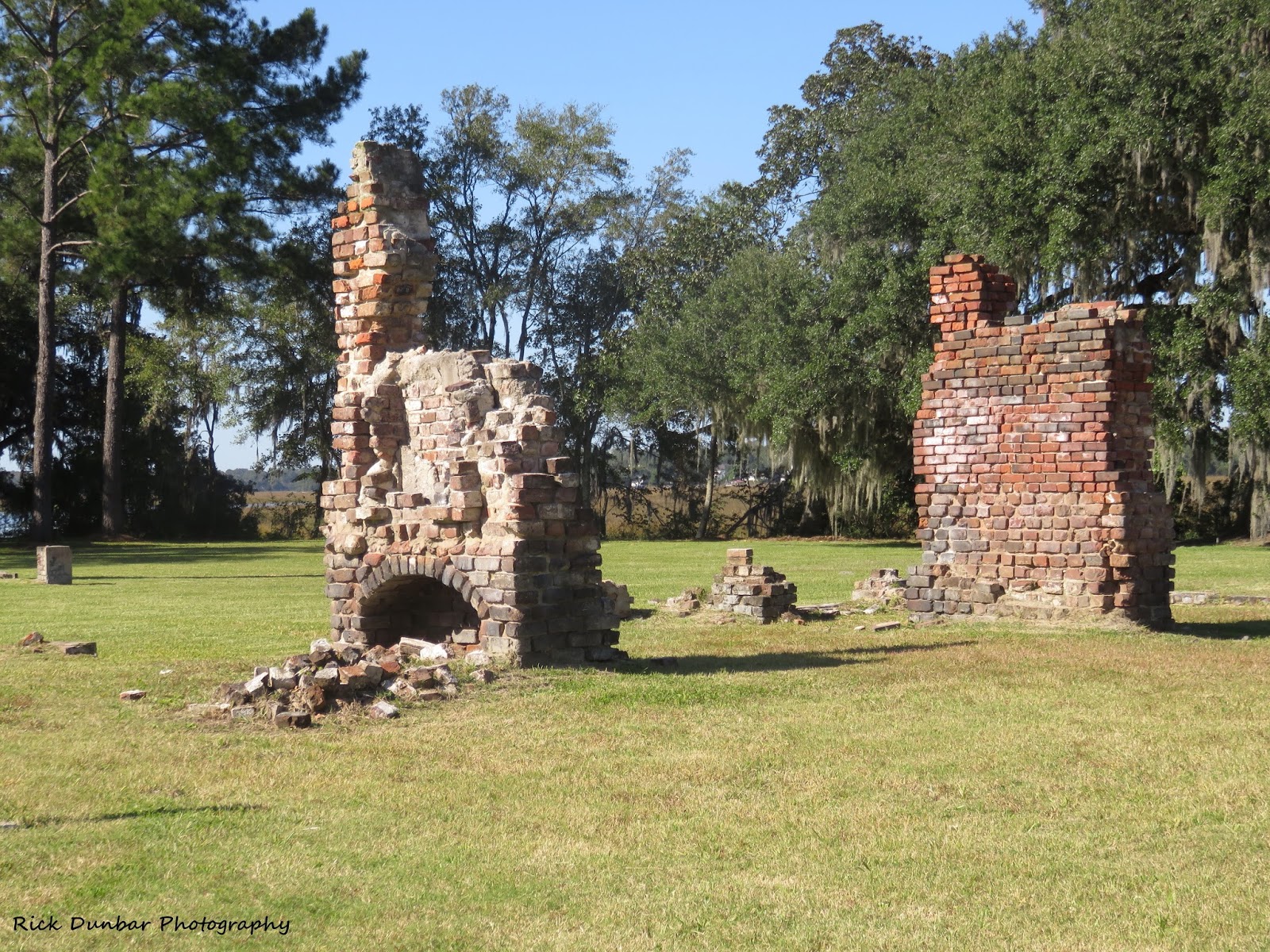
Pinckney rebuilt the home a third time. It was rumored to be one of the only country style Victorian homes in the Lowcountry. In 1995, it was purchased by the Whitfield's. The grim specter of fire revisited Runnymede again in 2002 and destroyed the home built by Pinckney. All that's left of the mansion is a partial outline of the home's perimeter, the brick entry steps, remnants of the brick fireplaces,


and the towering, two story chimney from the kitchen house.


Runnymede Plantation has a storied history interwoven with the folklore and superstitions of plantation living as big as its onetime 1,457 acres. One story tells of an African/American burial ground located deep within Runnymede's thick centuries old forests and an age old custom of placing personal items owned by the deceased in life on their graves--a custom with African roots. Items like plates, saucers, and drinking glasses if it was a woman or tools if it was a man, but not excluding items like a favorite chair.


The removal of any of these types of personal items from the graves of a dead person would result in consequences too terrible to imagine implicating swift retribution from the offended spirit. A belief implicitly held by hundreds of people living in the Lowcountry of South Carolina--including those who lived on Runnymede Plantation.


The plantation has a thick, untouched canopy of century old trees, numerous ponds and creeks, an unobstructed view of the Ashley River, and a unique place in Charleston's ancient and colorful plantation history.

A hauntingly powerful Southern tale from Runnymede's past: One September afternoon, two brothers from Charleston visited Runnymede Plantation for an end-of-summer outing; they were leaving the next morning to attend school in another state. One of the chief amusements enjoyed when visiting the old plantation was exploring its river and marshland setting in search of Lowcountry wildlife, such as the prowling alligator and abundant water fowl.

The two brothers were on such an excursion, an excursion that took them deep into Runnymede's surrounding forest where they happened upon an old slave burial ground. On the mounds of earth above where the remains of the people were buried, personal items belonging to the deceased person had been carefully placed. There were items like plates, cup and saucers, drinking glasses and favorite tools. Other items included such things as a favorite chair, a bottle of medicine and a spoon no doubt used to administer the medicine.

The brothers knew of the custom and the beliefs associated with the burial ground, but considering the beliefs to be just foolish superstition, they decided to play what they thought to be a humorous prank and disregarded what many Lowcountry people implicitly believed--the removal of an item from a grave or tampering with it in any way would bring swift and deadly retribution from the offended spirit. They removed a drinking glass from one of the graves and took it back to their home in Charleston.

When the parents saw the object, they questioned the brothers about it. The two brothers confessed to the prank. The parents were disappointed at the actions of their sons and became very concerned. It was not that they believed in the customs and rituals, but their concern was the disrespect their sons showed toward the people on Runnymede and their beliefs--beliefs handed down to them from their ancestors.

The parents immediately contacted the plantation owners and they insisted the item be returned at once to the burial ground and placed in its original position. It was returned. Word of the prank had spread throughout the plantation population, but it was believed their actions to undue the prank to be too late. Vengeance was probably already at work.

The brothers left for school out-of-state the next day, but they did not make it to their destination without deadly consequences. When word reached Runnymede of their unfortunate consequences, it was of no surprise to the people who firmly believed in such things. It was not unexpected.

Runnymede Plantation is located between Middleton Place and Magnolia Plantation. Unlike its more popular counterparts, it is not open to the public. It is open to scheduled weddings, private events, and concerts. You can check out its Facebook Page.

Friday, May 8, 2015

Get That Peaceful Easy Feeling--Wednesday Wine Stroll At Middleton Place

Schedule for 2022
With the Ashley River lazily meandering in the distance, a peaceful easy feeling came over me as I sat on a wooden bench leisurely sipping on a plastic cup of red wine. I was in the company of one of the oldest oak trees in the Charleston Lowcountry. Greyed from age and bearing the scars of a sometimes tumultuous past, the Great Oak's long, broad branches majestically overshadowed the calming waters of the Rice Fields where fish launched themselves into the air like mortar shells and alligators prowled the surface like the H. L. Hunley in search of an unwary prey.

Clinging to the tree's weather-beaten bark, a cardinal curiously watched my every move. We weren't alone. With the Octagonal Garden to the right and the Sundial Garden behind, the soft, intimate chatter and light laughter of fellow strollers navigating the garden's preened pathways filled the warm evening air. The occasion was Wednesday Wine Stroll at Middleton Place.


The Wednesday Wine Strolls were started as a way for visitors to experience the beauty of Middleton Place in the early evening light and a more relaxed atmosphere--no tour guides needed. It is just you, the gardens, and a world renowned vino. The Wine Strolls are an invitation to drink in the incomparable natural beauty of the plantations 274 year old gardens--the oldest landscaped gardens in America. Each week, samples of specially selected wines from around the world are uncorked by the Middleton Place Restaurant for you to savor. A different wine region and beautiful garden location in bloom is chosen for the stroll.


This week's selected location was the southern magnolia-lined walkway along the spring-fed Reflection Pond. The four white-cloth covered tables were evenly spread out under the tall trees the full distance of the pond and strategically located at pathway entrances for easy access into the sprawling gardens. On each table were two bottles of wine--one red and one white. Each setting was accompanied by a basket of crackers for cleansing the palette between tastings.


The wine region selected was South America. At Table One, Tomero Torrontes 2013 from Mendoza, Argentina was the white offering and Malma Malbec 2012 from Patagonia, Argentina was the red. At Table Two, the white offering was Cautivo Chardonnay 2014 from Mendoza and the red was Errazuric Max Reserva Carmenere from the Villa de Aconcagua, Chile 2011. Moving to Table Three, Arido Moscato 2013 from Mendoza was the white and Colonia Las Liebres Bonarda Clasico 2013 from Mendoza was the red. Table Four topped off the selections with a Sangria Blanco and a Sangria Roja.


The correct pronunciations I leave to you to figure out--some Spanish required. The Cautivo Chardonnay was my white wine favorite and the Bonarda Clasico was the red I sipped under the Great Oak. After a few glasses of the South American vino and a dash of imagination, I found myself rubbing shoulders and clinking glasses with Henry and Mary as a guest of their garden party. Blame my whimsical tryst to the past on the wine.


If you want to get that peaceful easy feeling, Middleton's Wednesday Wine Stroll is where you want to be. It is a perfect blend of fine wine and floral gardens accented with the aroma of magnolias and oaks interlaced with a tremendous concentration of gentle sunlight. With a long finish, this event is elegant and well-balanced...Enjoy the pictures.