Showing posts with label Runnymede Plantation. Show all posts

Sunday, February 8, 2026

A Lowcountry Legend from Runnymede Plantation—and the History that Shaped it

Runnymede Plantation 1917
In the Lowcountry, history is never just something you read in books. It breathes. It clings to the air like humidity, settles into the marsh grass, and whispers beneath the live oaks. Some stories rise from that landscape with such insistence that they become part of the region’s cultural marrow. The tale of what happened at Runnymede Plantation one September afternoon is one of them.

The year has slipped from memory, but the season has not. It was late summer, the kind of day when the Ashley River glints like hammered pewter and the cicada's drone with a last burst of bravado. Two brothers from Charleston—teenagers on the verge of leaving for school in another state—had come to Runnymede for a final outing before their departure. The plantation had long been a place of adventure for them, a patchwork of riverbank, marsh, and forest where boys could roam freely and imagine themselves explorers.

Runnymede Plantation today

Runnymede’s landscape, like much of the Lowcountry, is a living archive of natural and human history. Alligators patrol the rice‑field canals. Egrets lift from the reeds in sudden white flashes. And tucked deep within the woods are remnants of a past that is neither forgotten nor fully at rest. It was there, in the quiet shade of the forest, that the brothers stumbled upon an old slave burial ground.

To the untrained eye, the graves might have seemed simple—mounds of earth, weathered by time. But atop each one lay a careful arrangement of personal belongings: plates, cups, tools, a favorite chair, a bottle of medicine with a spoon resting beside it. These were not random objects. They were part of a tradition carried to the Lowcountry by Africans, rooted in West African cosmology. The practice—placing the deceased’s possessions atop the grave—reflected a belief that the boundary between the living and the dead was permeable. Objects used in life could accompany the spirit into the next world. To disturb them was to disturb the dead themselves.

By the nineteenth century, this tradition had become deeply woven into Gullah‑Geechee culture. Even those who did not personally believe in the spiritual consequences respected the custom. It was an act of reverence, a recognition of humanity in a world that had denied it. The brothers knew the stories. Everyone in the Lowcountry did. But youth have a way of mistaking knowledge for immunity.

Seeing the objects laid out on the graves, the boys decided to play what they considered a harmless prank. They lifted a drinking glass from one of the mounds—laughing, perhaps, at the idea of “superstition”—and carried it home to Charleston as a souvenir. Their parents did not share their amusement.

They weren’t believers in curses, but they understood the weight of what had been done. The issue was not fear of spirits. It was respect—respect for the people buried at Runnymede, for the descendants who still lived nearby, and for the cultural traditions that had survived enslavement, war, and time itself. The parents contacted the plantation owners immediately. The glass was returned to the burial ground and placed exactly where it had been. But word had already spread among the community at Runnymede. And the consensus was quiet, solemn, and unwavering. It was too late.

The next morning, the brothers boarded the jet for school. They never arrived. The details of the tragedy have blurred with retelling—some say an accident, others a sudden illness—but the outcome was the same. When news reached Runnymede, no one expressed shock. No one questioned how such misfortune could have happened. Among those who held fast to the old beliefs, the explanation was simple. The spirits had been disturbed.

Whether one believes in supernatural retribution or not, the tale endures because it speaks to something deeper than folklore. It is a reminder of the cultural traditions carried by Africans—traditions that survived against all odds and still shape the Lowcountry’s identity. It is also a story about reverence: for the past, and for the communities whose histories are too often overlooked.

Runnymede Plantation, like so many places in the South, holds layers of memory. Some are beautiful. Some are painful. All deserve respect. And sometimes, the land itself seems to insist on it.


Note: This story is a mix of some fiction and historical facts. However, it is associated with an actual event.

Runnymede Plantation is not open to the public. It is used for special events and weddings.

Tuesday, October 28, 2025

The Whispering Alphabet of Runnymede Plantation

The moon hung low over the Ashley River, its pale reflection trembling across the black water like a secret trying not to be spoken. Beneath its glow, Runnymede Plantation stood like a monument to memory itself—its chimney a solitary sentinel rose into the sky, its oaks draped in Spanish moss that swayed like mourning veils in the humid breeze. An impressive avenue of live oaks led to the haunting estate, their limbs arching overhead like cathedral vaults. A second avenue, consisting of a skyline hedge of Southern Magnolias, bordered the garden in fragrant silence, their waxy blossoms glowing faintly in the moonlight.

Elias Carrington had come alone. In his hands he carried the parchment containing the verses written by Poe as he strolled the garden. The edges were brittle, the ink faded in places, but the rhythm of the lines still pulsed with eerie vitality. Local lore held that Poe had been a frequent visitor, slipping away from Fort Moultrie during his brief military posting in Charleston to wander the plantation’s shadowed paths, drawn to Runnymede’s spectral beauty and the strange Alphabet Walk that twisted through its gardens like a living cipher.

He was seen once, they said, beneath the Cypress tree at twilight, murmuring lines to himself and scribbling furiously in a leather-bound journal. The gardener’s daughter swore she saw him bury something beneath the tree—a scroll, perhaps, or a letter sealed with wax and marked with a raven.

Nothing prepared Elias for the visceral unease that crept into his bones as he stepped onto the Alphabet Walk. The trees loomed like sentinels of an ancient code; each one marked with a brass plaque bearing a single letter. A for Ash, B for Birch, C for Cypress… and so on, winding deep into the garden’s heart.

He paused beneath the twisted limbs of a Hackberry tree marked with an H. The plaque was tarnished, but beneath the grime he saw a faint engraving: “Heed the hush.” He turned. The wind had stopped. The garden was silent. Then came the whisper. It wasn’t a voice, not exactly. More like a memory brushing past his ear. A line of verse, half-formed and aching to be remembered:

"In twilight’s hush where shadows creep,
And ancient oaks their secrets keep,
I wandered lost through paths of lore,
Where time had locked a hidden door."

Elias scribbled it down in his notebook, heart pounding. He had found the first clue.

The Alphabet Walk twisted unexpectedly, leading him to a grove where the trees grew closer together, their branches interlaced like the strands of a wicker chair. Here, the letters grew stranger—Q for Quince, X for Xylosma, Z for Zelkova. Poe had walked this path. It was said Poe had whispered his poem into the bark of these trees, each line a cipher, each stanza a map.

"U urges fate to turn its face,
V veils the vow of love’s embrace,
W wakes the wind to cry,
X marks the spot where secrets lie."

At the base of the Zelkova, Elias found a stone half-buried in moss. It bore a carving: a raven in flight, its wings outstretched over a scroll. Beneath it, a single word etched in Latin: “Veritas.” The final lines of Poe’s poem read:

"But truth is not for hearts untried—
It waits where sea and soul collide.
Seek not the gold, nor glory’s flame,
But speak the word that none dare name."

Elias stood in the hush of the garden, the wind returning with a sigh through the magnolias. He felt the weight of time pressing against him—not just the plantation’s haunted past, but the burden of secrets kept too long. Somewhere, beneath the sand and salt of Sullivan’s Island, a scroll waited. And on it, the name of a treasure lost to time.

But tonight, the garden had given him its first whisper. And the Alphabet Walk, it seemed, was only beginning to speak.


The Haunting Ashley River Plantation Just a Buggy Ride from Magnolia Plantation

Friday, April 1, 2016

The Extraordinary Ashley River Corridor--22 miles of Antebellum history

Beginning at Slands Bridge in Summerville and extending 22 winding miles through thick stands of moss covered oaks and dense marshes to the site of Charleston's first settlement in 1670, its brackish waters and pluff mud shoreline is saturated with early Antebellum history. Including the Colonial Dorchester settlement and the Ashley Barony site, it was both a thoroughfare and a lifeline in the hand of early Charleston for its dependent downstream settlements and expansive plantations.


Relatively undisturbed by the passing of time, it is unparalleled in its historic significance and natural value. People by the droves come from all over the United States to its shores to drink in its tranquility and wonder at its one-time opulence. Middleton Place, Magnolia Plantation, Drayton Hall, and the lesser known Runnymede Plantation are poetic names enduringly written on its adjoining signposts that welcome visitors to its riverside gardens and reflective ponds. Rich with a wide variety of fish and wildlife, these scenic vistas are all a part of the extraordinary tidal river named after the 1675 Chief Lord Proprietor of the Carolina Colony, Anthony Ashley Cooper.

 
With 26 separate sites listed in the National Register of Historic Places and designated a State Scenic River, this was and is the Ashley River Corridor. Enjoy the pictures of the Ashley River.

Runnymede Plantation Ashley River
Runnymede Plantation
 
Middleton Place
Middleton Place Ashley River
 
Colonial Dorchester Ashley River
Colonial Dorchester
 
Drayton Hall
Drayton Hall Ashley River

Friday, October 23, 2015

The Haunting Ashley River Plantation Just A Buggy Ride From Magnolia Plantation

The narrative of the unpretentious plantation located on Ashley River Road just a buggy ride from Magnolia Plantation stokes ones imagination. In the midday sun, it is inspirational, at dimday, unearthly. When the sun has disappeared from the changing skyline and the cloak of night has smothered the colors of light, the once sprawling shadows cast by the estate's ancient oak and singular chimney in the light of day melt away into the blackening landscape.

Standing amidst the old ruins, you sense there is something more than what meets the eye, something beguiling. The pervasive darkness and penetrating river atmosphere nourish the unsettling side of ones spirit. The heavy measure of primitive folklore from the plantations haunting Antebellum past permeates every weatherworn rock, moss covered tree and jaded brick. The ominous voices of yesteryear whisper disquieting words in your ear and the hairs on the back of your neck begin to dance. At that moment, you will have experienced the privilege of living the wonder and mystery that is Runnymede Plantation.


Part of Drayton properties in 1709 and developed before the Revolution, an impressive avenue of live oaks led to the haunting estate. In 1898-1903, a second avenue was added consisting of a skyline hedge of Southern Magnolias. Its gardens were extraordinary and in scale with those of Middleton and Magnolia. At the same time the avenue of Magnolias were planted, a third mystic path was added.


It was called the Alphabet Walk. The name of each tree lining the walk began with a different letter of the alphabet. There is a tradition the different letters spelled a secret word, but no one has ever solved the arboreal acrostic. Along such magical paths and under the ancient trees along Ashley River Road, Edgar Allen Poe quite possibly walked when he lived in Charleston. One finds just such mystical woodlands in his haunting tales. Unfortunately, the extensive gardens of Runnymede were obliterated by menacing elements.


The name of the plantation was inspired by a thousand year old oak on the estate located at the center of a large meadow overlooking the Ashley River. The pastoral scene reminded the owners of a property in England with a similar setting--its name, Runnymede.


The plantation has been known by three different names during its over three hundred years of history. Its oldest name was "Greenville." Later, it was named after the wife of one of the owner's and called "Sarah Place." After a fire destroyed the original mansion during the later part of the 18th century, the Pringle's built a new mansion and named it after the property in England, Runnymede.


Later, Charles C. Pinckney purchased Runnymede from the Pringle's son, William Bull. In 1865, the mansion built by the Pringle's suffered the same fate as the original. It was destroyed by a fire, a fire set by Sherman's raiders--likely the same troops that burned Middleton Place and Magnolia.


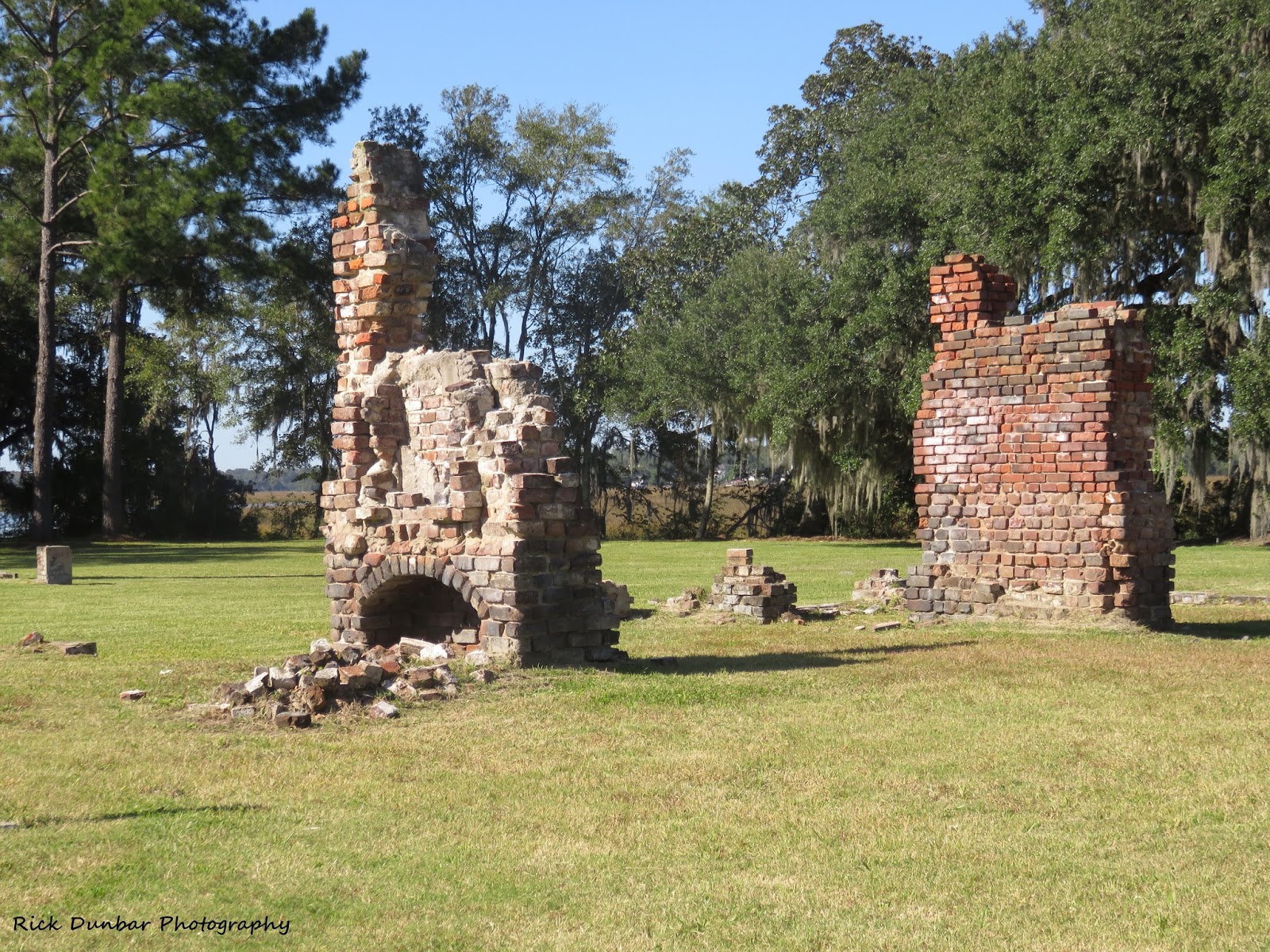
Pinckney rebuilt the home a third time. It was rumored to be one of the only country style Victorian homes in the Lowcountry. In 1995, it was purchased by the Whitfield's. The grim specter of fire revisited Runnymede again in 2002 and destroyed the home built by Pinckney. All that's left of the mansion is a partial outline of the home's perimeter, the brick entry steps, remnants of the brick fireplaces,


and the towering, two story chimney from the kitchen house.


Runnymede Plantation has a storied history interwoven with the folklore and superstitions of plantation living as big as its onetime 1,457 acres. One story tells of an African/American burial ground located deep within Runnymede's thick centuries old forests and an age old custom of placing personal items owned by the deceased in life on their graves--a custom with African roots. Items like plates, saucers, and drinking glasses if it was a woman or tools if it was a man, but not excluding items like a favorite chair.


The removal of any of these types of personal items from the graves of a dead person would result in consequences too terrible to imagine implicating swift retribution from the offended spirit. A belief implicitly held by hundreds of people living in the Lowcountry of South Carolina--including those who lived on Runnymede Plantation.


The plantation has a thick, untouched canopy of century old trees, numerous ponds and creeks, an unobstructed view of the Ashley River, and a unique place in Charleston's ancient and colorful plantation history.

A hauntingly powerful Southern tale from Runnymede's past: One September afternoon, two brothers from Charleston visited Runnymede Plantation for an end-of-summer outing; they were leaving the next morning to attend school in another state. One of the chief amusements enjoyed when visiting the old plantation was exploring its river and marshland setting in search of Lowcountry wildlife, such as the prowling alligator and abundant water fowl.

The two brothers were on such an excursion, an excursion that took them deep into Runnymede's surrounding forest where they happened upon an old slave burial ground. On the mounds of earth above where the remains of the people were buried, personal items belonging to the deceased person had been carefully placed. There were items like plates, cup and saucers, drinking glasses and favorite tools. Other items included such things as a favorite chair, a bottle of medicine and a spoon no doubt used to administer the medicine.

The brothers knew of the custom and the beliefs associated with the burial ground, but considering the beliefs to be just foolish superstition, they decided to play what they thought to be a humorous prank and disregarded what many Lowcountry people implicitly believed--the removal of an item from a grave or tampering with it in any way would bring swift and deadly retribution from the offended spirit. They removed a drinking glass from one of the graves and took it back to their home in Charleston.

When the parents saw the object, they questioned the brothers about it. The two brothers confessed to the prank. The parents were disappointed at the actions of their sons and became very concerned. It was not that they believed in the customs and rituals, but their concern was the disrespect their sons showed toward the people on Runnymede and their beliefs--beliefs handed down to them from their ancestors.

The parents immediately contacted the plantation owners and they insisted the item be returned at once to the burial ground and placed in its original position. It was returned. Word of the prank had spread throughout the plantation population, but it was believed their actions to undue the prank to be too late. Vengeance was probably already at work.

The brothers left for school out-of-state the next day, but they did not make it to their destination without deadly consequences. When word reached Runnymede of their unfortunate consequences, it was of no surprise to the people who firmly believed in such things. It was not unexpected.

Runnymede Plantation is located between Middleton Place and Magnolia Plantation. Unlike its more popular counterparts, it is not open to the public. It is open to scheduled weddings, private events, and concerts. You can check out its Facebook Page.

Wednesday, May 28, 2014

Charleston To Sweden--An Extraordinary Hotel That Hangs With The Trees

The tree is by far the biggest, tallest and most prolific of the living things with whom we share this beautiful planet. They have been venerated by ancient cultures and protected by modern laws--Summerville, SC adopted the motto "Sacra Pinus Esto"--"The Pine is Sacred."

The lungs of the earth, trees pull carbon dioxide from the atmosphere and return oxygen. They fuel the fires that keep us warm on frigid days, they provide the products we use to shelter our families, and are the inspiration of many poems.

Right here in our beloved Lowcountry, Angel Oak on John's Island is reportedly the oldest living thing east of the Rockies. Coming in at 1,500 years, it is not the tallest or the oldest, but its branches spread out over the landscape some 89 feet with a trunk circumference of 25.5 feet. Unknown to many Lowcountry residents, in the middle of Runnymede Plantation on the Ashley stands an oak tree with a circumference of 29 feet. Simply called the Oak, it is about 1,000 years old.

The biggest tree in the world is a giant sequoia named after a Civil War leader, "General Sherman." Located in Sequoia National Park in Tulare County, CA, it has a girth of 102.6 feet at ground level. The world's tallest tree is a coast redwood located in Redwood National Park, California. It is named "Hyperion," after a person in Greek mythology, and stands no less than 379.7 feet tall.

The world's oldest non-clonal tree is a pine tree located in the White Mountains of Inyo County in eastern California. In 2014, it turned 4,845 years old. It is fittingly named after a Biblical figure of longevity, Methuselah. The world's oldest clonal tree is a mere 16 feet tall and believed to be 9,550 years ancient. It is a Norway Spruce located on the Fulufjället Mountain of Dalarna province in Sweden.


Once in awhile, I write about places to see and things to do at destinations other than Charleston and Sweden, the location of the aforementioned oldest tree, is home to an extraordinary amenity that leaps out of the box of conventionalism.


Sweden is a country with long, rugged coastlines, 95,700 lakes, deep forests, rolling hills, majestic mountains, hundreds of unspoiled islands, and summer houses. With a reputation for cold winters, the climate can be much milder than you might expect because of a warm Gulf Stream. The landscape is dotted with small villages and Harads is one of them--a village of 600 featuring a restaurant, shop and guest house. From there, it is just a five-minute stroll through the beautiful Swedish landscape to five treerooms with a fantastic view of the Lule River valley, miles of forest and the powerful river. It is aptly called the Tree Hotel and was inspired by the film "The Tree Lover" by Jonas Selberg Augustsen.


The Birds Nest
On arrival, you check in at Britta’s pensionat where breakfast, lunch and dinner are served Tree Hotel guests. A buffet breakfast is always included in the room price, as are all meals in the package deals. Britta’s pensionat has an authentic 1930-50’s setting and offers a restaurant, bar, sauna and relaxation area, TV, and internet. The treerooms do not have TV and internet. Focus is on nature.

The Mirrorcube
The UFO
The list of activities is long and include a guided tour of the hotel, walking tour of Harads, Tree Sauna, trekking the Nordic flora and fauna of Storklints, mountain biking, kayaking the historic Lule river, tour by horse, midnight riding under the Northern Lights, fishing the beautiful Bodträsk River, and riding a zipline.

Treeroom rates: from 4400 SEK=$677.44 US to 4600 SEK=$698.09 US for two or 3300=$500.80 US for one. Extra adult: 850 SEK=$128.31 US and extra child: 450 SEK=$67.93 US. Rates may have changed. The Dragonfly rates are 7200 SEK=$1086.86 US 2 to 4 persons--6800 SEK=$1026.48 US in the summer season July-August.

View from the Blue Cone
It is a long trip from Charleston to the beautiful land of Sweden. The Tree Hotel is a once in a lifetime experience of the extraordinary kind. It is a place where you can forget about the time constraints of everyday life, enjoy the serenity of unspoiled nature, and rejuvenate in a sophisticated yet familiar environment. A place where you can become one with the oldest of our planet's inhabitants.